Choosing the Right Anchor for Your Boat
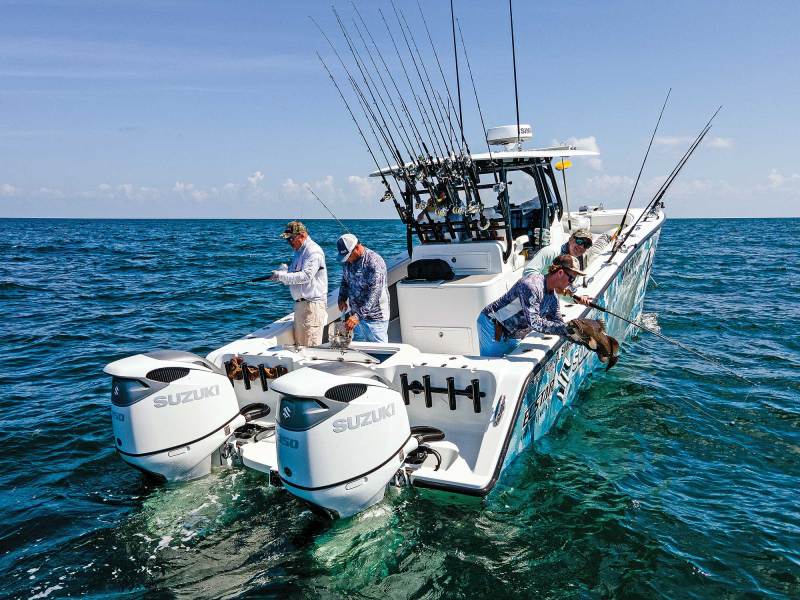 Anchoring up to fish a structure spot such as a wreck, reef or rock pile often proves the best method for consistent action. Selecting the best anchor keeps you on the spot and the fish.
Courtesy Suzuki Marine
Although there are many new-fangled, high-tech ways to keep a boat from drifting with the wind and tide, the real-deal anchor isn’t going the way of the buggy whip anytime soon. In fact, there are times when an anchor is a better choice over anything else for fishing and other scenarios.
When chumming, for example, anchoring is the best way to make sure the slick from your chum block leads back to your boat. Using a trolling motor or virtual anchor like Mercury’s Skyhook to hold position can move the boat away from its starting point, and the prop turbulence can disperse the slick.
During a mechanical failure, anchoring is the best way to make sure the problem isn’t complicated by your boat being swept out to sea through a raging, rocky inlet. Besides, if you have to call a tow service, having coordinates that don’t change is a plus.
When fishing a specific location that is a known fish producer, anchoring is the stealthiest way to hold the boat in the correct position. Plus, an anchor doesn’t burn gas, increase engine hours or drain batteries. Yet, what anchor should you choose?
Seabed SavvyThe first step in deciding which anchor to use is knowing what’s on the bottom in places you’re likely to drop the hook. Most charts on a multifunction display are derived from NOAA charts, which label seabed composition with easy-to-decipher abbreviations, such as sand (S), mud (M), rock (R), shell (SH), and my favorite, ooze (OZ).
Use your sonar to distinguish between soft and hard bottom. Soft bottom echo returns are thin, while hard bottom returns are thicker, have brighter colors and may have a secondary return beneath the first.
Fluke StyleCertain anchors work best on different sea bottoms. For soft mud and sand, nothing beats a Danforth-style anchor with its large, sharply pointed flukes. They are not as good on grassy or hard seabeds. I was at a four-day anchor test sponsored by Fortress. In a muddy section of the Chesapeake where we tested, Fortress’s aluminum fluke-style anchor proved to have the best holding power, thanks in part to its 45-degree-angle wide mud option. The wider setting is not good on other sea bottoms, though.
Read Next: Conventional vs. Virtual Anchoring
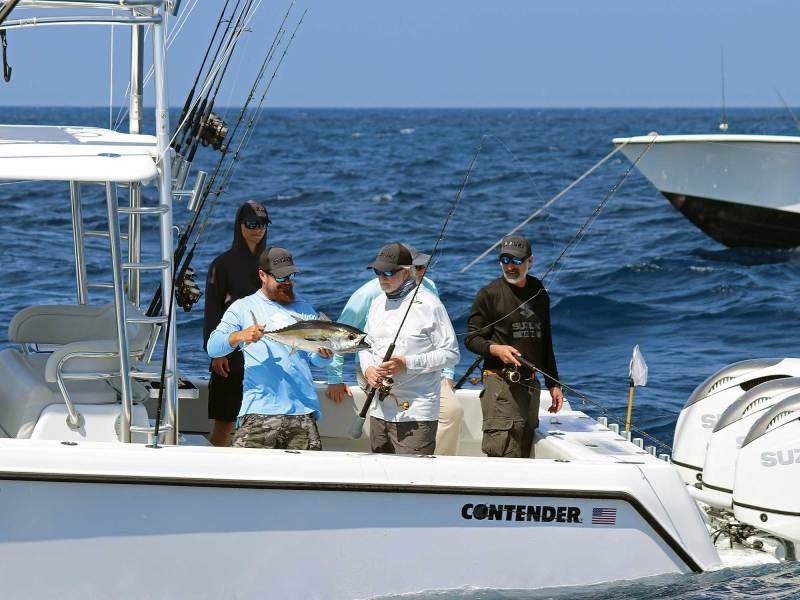 Anchoring is the stealthiest way to hold the boat in the correct position.
Courtesy Suzuki Marine
Plow Anchors
For harder bottoms or ones with grass, new-generation spade-style anchors like the Rocna MK II, Viking Odin, Mantus M2, and Manson Supreme have sharp tips that bury quickly and work well. The same goes for traditional plow-type anchors like the Lewmar DTX, CQR and Lewmar Delta.
For overall performance on a wide variety of seabeds, many boaters still swear by the Bruce-style anchor, which has a triple fluke design that is self-righting and handles situations like wind shifts without disengaging and resetting. In Salt Strong’s recent anchor test, this was the surprise winner. But, if I had to choose only one anchor, an authentic Danforth would be my top choice.
Grapnel AnchorsWhen over rocky sea floors, a grapnel-style anchor with many prongs works best, but these are practically useless everywhere else. If using a more traditional anchor in rocky areas, use a trip line, which lifts the anchor on the opposite end of the shank to dislodge it if it becomes stuck. If there’s enough storage space, carry more than one style anchor to handle different seabeds.
Sadly, a lot of online information about anchors is AI-generated and proves the new adage that a lot of information is a dangerous thing. A clue that the article you’re looking at is computer-generated lies in the photos. If all the anchors shown look like the anchor tattoos on Popeye’s arms, keep searching. You are better off visiting a trusted source like this site.
Anchoring TipsHere are some tried-and-true anchoring tips.
- When in doubt on anchor sizing, get the bigger one. In most circumstances, having a 5-to-1 scope, which means paying out 5 feet of line for every foot of depth, is a good baseline. Let out more if the current is ripping or the wind is howling.
- A length of chain has the same effect of increasing the scope and holding power, but too much chain can make weighing anchor a back-breaking task.
- Don’t toss the anchor. Drop it and let it “fly” to the bottom.
- Bump the engine in reverse to make sure it’s set.
- Anchor choice is highly dependent on the area where it’s being used and the size of the boat. Copying the choice of local fishing guides with similar boats is a good strategy; they know what works.
The post Choosing the Right Anchor for Your Boat appeared first on Salt Water Sportsman.