Lake Champlain and the Battle That Saved a Revolution
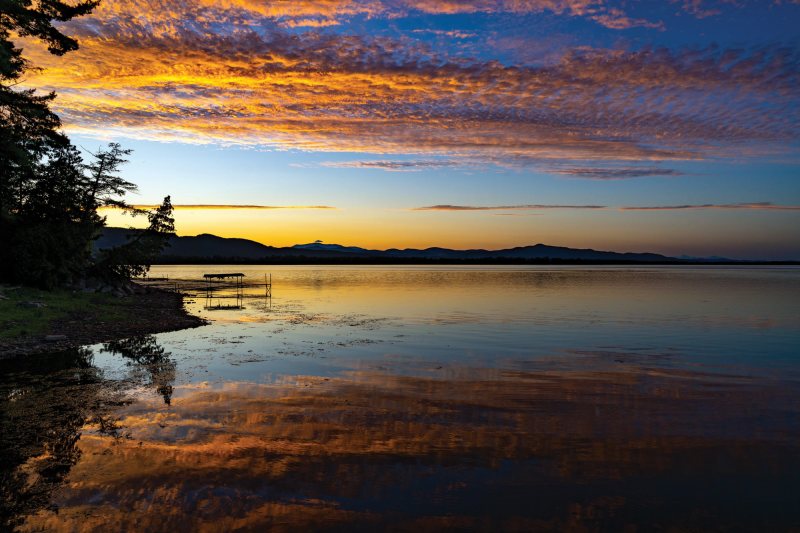 Lake Champlain is 120 miles of stunning freshwater sailing, and one of the most consequential bodies of water in American history.
james/stock.adobe.com
It is possible to sail the length and circumference of Lake Champlain, some 120 long by 587 miles of shoreline, and not know a thing about it.
Oh, you’ll see unbroken stretches of green backed by blue mountains east and west. The winds might allow an all-day sail with a drifter until a sudden squall tests your reefing skills. The water, for the most part, will be clear. If you fish, you’ll want ice aboard. At certain times of the year, you might not encounter another boat unless you stop at one of 30-plus marinas or anchor in one of dozens of coves.
But if you do only that, you will have missed Champlain’s essence. You will have skimmed across America’s founding waters on winds that, if turned around, could have had us speaking the King’s English. You would have failed to acknowledge lives lost fighting for half a dozen empires that plied the lake for centuries. Their ghosts, some feel, linger above 300 sunken wrecks that, in places, can be seen from the surface, easily dived.
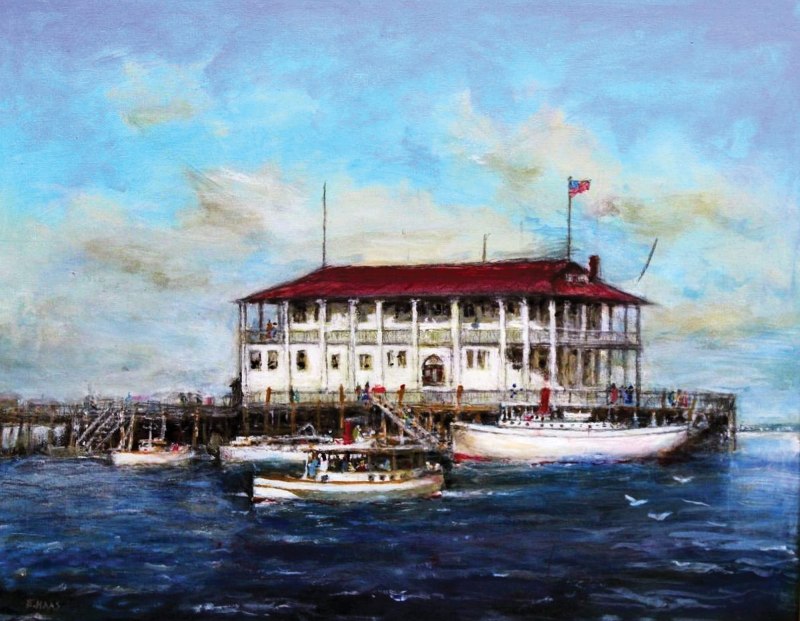 The Lake Champlain Yacht Club, circa 1918, depicted in an Ernest Haas acrylic painting.
Courtesy Lake Champlain Maritime Museum
Even if you know the lake’s history it’s unlikely that you can appreciate hundreds of people who have worked since the Sixties to return the lake to its native condition. Their efforts are not yet finished.
Champlain’s story is all about sailing. Unique for a freshwater lake, its winds have powered three eras: conflict, commerce and recreation. The last is evolving, as the lake’s lure is exploited again, 417 years after French explorer Samuel de Champlain became the first European to map it. Rather than swooning over its July 1609 beauty, Champlain’s journal describes a serpent-like creature, 5 feet long with scales and sharp teeth, and a battle with Indians in which he killed two with one shot of his arquebus, and tortured another by tearing limbs and roasting until another shot put him out of his misery. The Frenchman’s arrival was a harbinger.
This year marks the 250th anniversary of the Battle of Valcour Island between 500 Vermonters, many of them farm boys, on 54-foot gunboats—little more than open barges with a single mast and three cannons—and a British Navy with 700 trained sailors on twice the number of boats, including two ships with more firepower than the entire American fleet. They met on October 11, 1776, in a narrow gap between the 1,000-acre island and the New York shore 25 miles from Canada. At its simplest, the story can be understood by beginners who learn that sailboats don’t like to go straight into the wind.
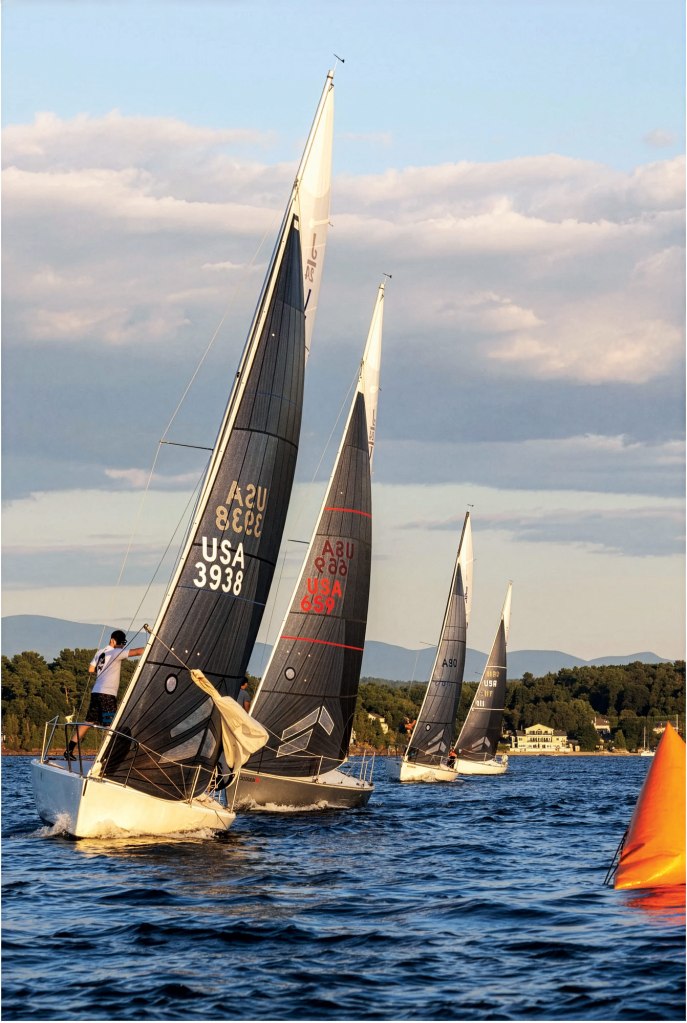 Thursday night racing with the Malletts Bay Boat Club, where short seasons and long fetches produce serious sailors.
Lea Ann Smith
That was Benedict Arnold’s strategy as he anchored a line of 15 boats across the gap and forced the Brits, who were chasing him on northerly winds, to round the island and beat up to a standstill. There, the two sides slung a junkyard of iron bullets, cannonballs, dumbbells and spheres full of murderous shrapnel. Fifty-five Americans died, and their largest ship, the Royal Savage, was aground and burning as darkness fell. Late that night, Arnold guided his remaining boats through a gap in the British line, rowing quietly, single file, guided by a lantern on each stern. At dawn, the British spotted the fleet headed south. They caught them 50 miles later near Panton, where, under fire, Arnold beached and burned the remains of his navy, and led 200 men to Ticonderoga. With winter approaching, the British commander decided to retreat to Canada and finish the job in the spring. That delay changed history. It gave Arnold and General Horatio Gates time to marshal troops and firepower to defeat the British at Saratoga, N.Y., a victory that brought the French into the war. Historians have written: The US lost the battle of Valcour and won the American Revolution.
We know a lot about the Valcour battle because of a map that a British officer, William Faden, drew after being there, and underwater archaeology that painstakingly gathered ship parts that souvenir divers had not scavenged.
From space, Lake Champlain resembles a jagged crack in the earth. Over millions of years, the valley went from a saltwater sea with coral and whales to a freshwater lake tipped northward to drain at 3 miles an hour into the St. Lawrence River. This means the “top” of the lake is at the south end. It has been suggested that at least one prehistoric serpent could have been trapped in the lake. Her name is Champ, and she swims through our imaginations as the lake’s mascot.
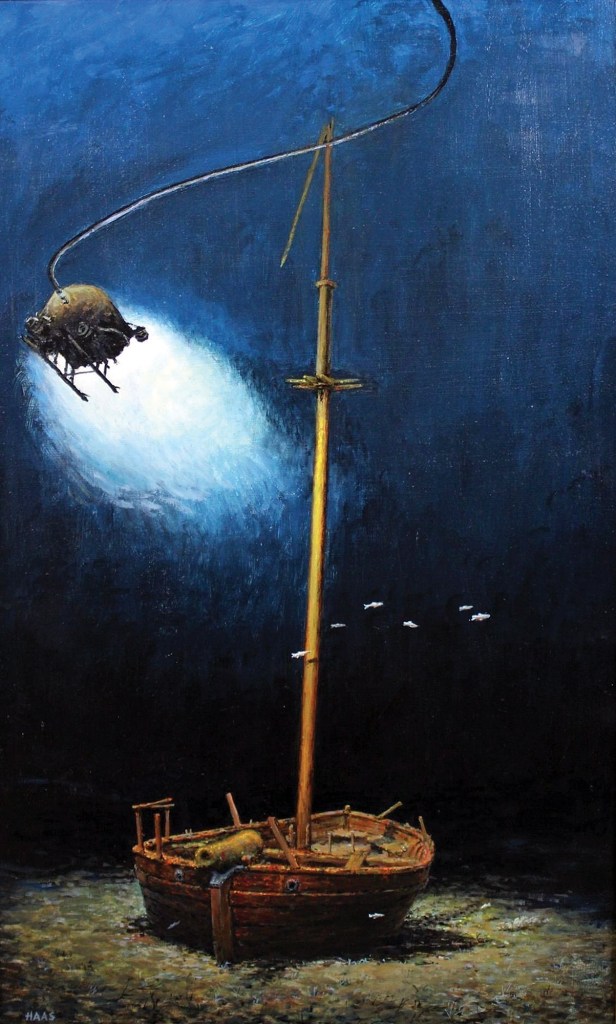 An ROV views Spitfire, Benedict Arnold’s last surviving gunboat, mast still standing.
Courtesy Lake Champlain Maritime Museum
Through this valley framed by New York’s Adirondacks on the west and Vermont’s Green Mountains on the east, summer winds blow from the southwest 42 percent of the time, and from the north-northwest 22 percent of the time. It can be calm in the morning interrupted by afternoon thunderstorms from New York. In no time, 25-knot winds, some with lightning, push choppy whitecaps into les moutons—aptly resembling stampeding sheep.
“Lake Champlain produces great sailors,” said Bill Bresee, who has boated on Champlain for 25 years. With a short season, the sailing club at the University of Vermont begins practice before the lake is clear of ice, and has produced All-Americans Clinton Hayes and Catherine Solsvig. With a long fetch, southerlies can produce waves comparable to those off Rhode Island, said club member Ryan Thompson.
Champlain’s breezes also created what is often called America’s first superhighway. For centuries, canoes went up and down, portaged at either end, north to the St. Lawrence River, south to the Hudson. It is tortuous to even read how the US and British took apart entire ships, pulled the empty hulls with ox past the rapids of the Richelieu to the north and south through the forests of New York, and reassembled the parts to carry on war.
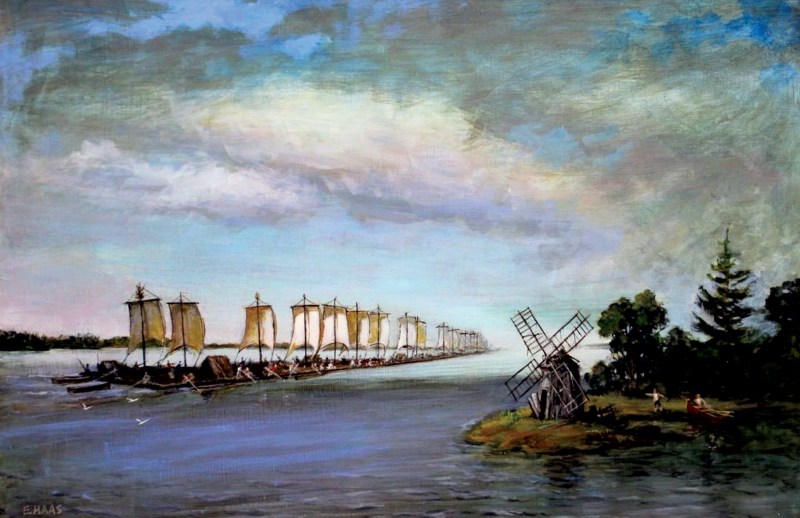 Smuggling logs with wind power.
Courtesy Lake Champlain Maritime Museum
When peace settled over the colonies, commerce began in earnest. Long before roads and rails encircled the lake, sailing ferries carried livestock, ore, grain, people and manufactured goods between ports. The digging of two canals with locks, Champlain in 1823 and Canada’s Chambly in 1831, connected the waters. Wind-powered, shallow-draft barges traded up, down and across the lake. Square sails pushed rafts of logs north and south. Burlington became a major port as Vermont’s forests were laid bare to supply New York City and Quebec with wood. The era of windblown commercial sailing declined after the first steamship, the Vermont, arrived in 1809.
Not long after, private yachts found the lake, according to W.H.H. ”Adirondack” Murray, whose small 1890 book, Lake Champlain and Its Shores, gushed prose that Madison Avenue would have embraced: “I know of no other spot which for loveliness of appearance, majesty of scenery, and varied resources of entertainment can compare with Lake Champlain,” he wrote. “It is the most beautiful lake on the continent. … It is beyond question the safest sailing and cruising ground that the amateur yachtsman can find. … Its shores and bays are alive with historic memories, which quicken patriotism and ennoble the character of whosoever receives their inspiration. … I foresee the day when a thousand pleasure yachts shall whiten those blue waters with sails.”
The book even contains sailing directions: “On the east side of Valcour Island, about a third of the distance from the southern end, is Smugglers Cove. This is a small recess of water with a narrow entrance. It is a pretty, secluded spot to lunch or camp in.”
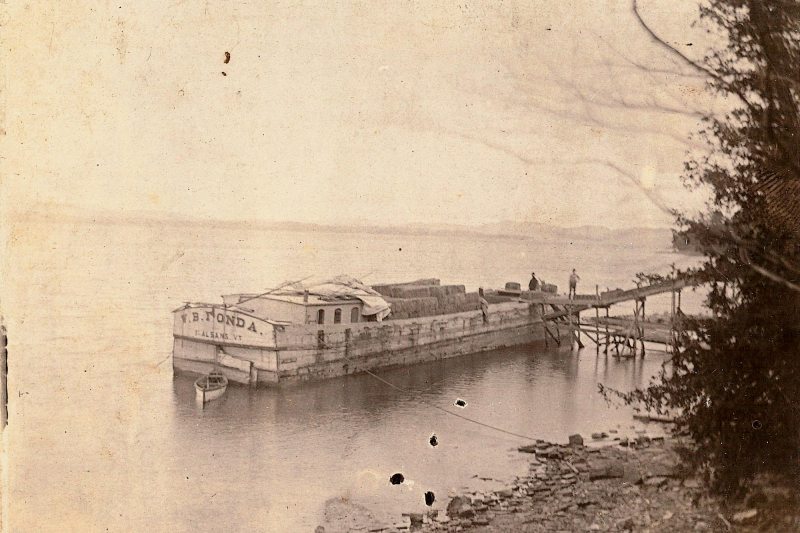 The sail barge W.B. Fonda loading hay.
At the time, sailing’s epicenter was the Lake Champlain Yacht Club, “naturally composed of gentlemen of intelligence, public spirit and standing.” He describes its clubhouse at the Burlington waterfront where members and guests could sit on a shady balcony and gaze out at “passing sails and steamers.”
Alas, the yacht club burned down (twice), and was replaced over time with a replica-looking structure open to all. Begun under socialist Mayor Bernie Sanders and resting on the law of public trust, Burlington’s industrial waterfront was transformed into a commons where families could take a rowboat out for free, or rent a small sailboat—one of them compliant with the Americans with Disabilities Act—and learn to sail. Fronted today by a boardwalk and expanse of lawn without T-shirt shops, a clutch of slips hold a dozen watercraft that, for $50, take tourists out for a couple of hours on the water.
Sample sailors today, and you’ll hear echoes of Murray’s poetry. The yacht club, now based in quiet Shelburne Bay, still boasts Burlington’s elite who maintain the club and moorings, and whose members are among the most ardent lovers of the lake’s mix of history, challenging winds and quiet coves. The club maintains two moorings off Valcour, and holds an annual Macdonough race to honor US Commodore Thomas Macdonough who, in the War of 1812, cleverly lured the British to Plattsburgh harbor. Using contrary winds, an anchor and a swing cable, he positioned his ship Saratoga broadside to the British Confiance and battered it into surrendering. Four months later, on Christmas Eve 1814, Britain signed a treaty that left the US-Canada border alone.
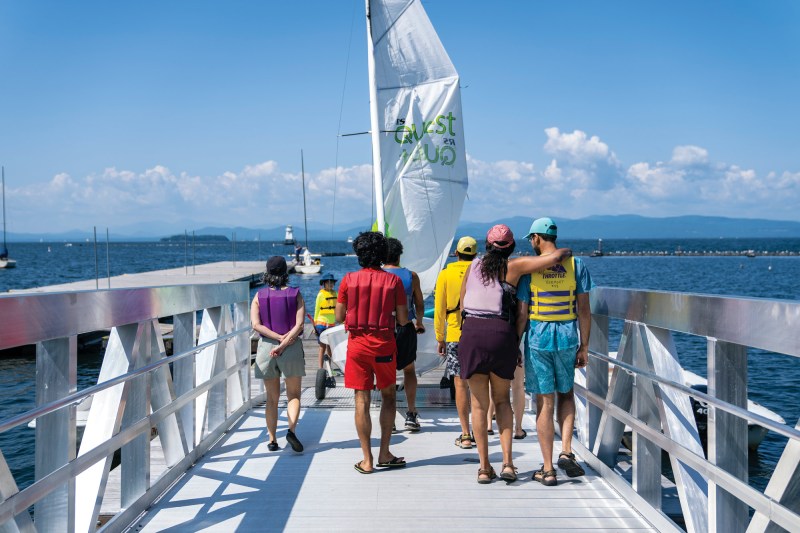 Future sailors at the Community Sailing Center.
Courtesy Community Sailing Center
“When you think back to the revolutionary period, I struggle with the question, ‘Why did the battle exist here?’” said club member David Main. “With a satellite image today, you can see the whole thing. But back then they didn’t. It’s fascinating to think that they were like, ‘This is a crucial piece of water to control,’ and they did.”
Rob Peterson, who runs the Burlington waterfront, said, “People who come to this lake, there’s almost a spiritual connection. I took a walk last night and just stopped. The sun was going down. I’ve spent the majority of my life and career working on Lake Champlain, and it still stops me in my tracks. I’m here every single day, and some of what I do is very unsavory, like cleaning public restrooms and picking up trash, and all I have to do is look out, and I’m blown away.”
During the pandemic, Peterson took his kids for a boat ride. “The lake was glassy, and I looked up at the moon,” he says. “It was this waxing crescent moon, and the stars were out, and there was something about the light in the sky. I just thought, wow, this is the definition of serenity and peace. My kids talk about that night to this day.”
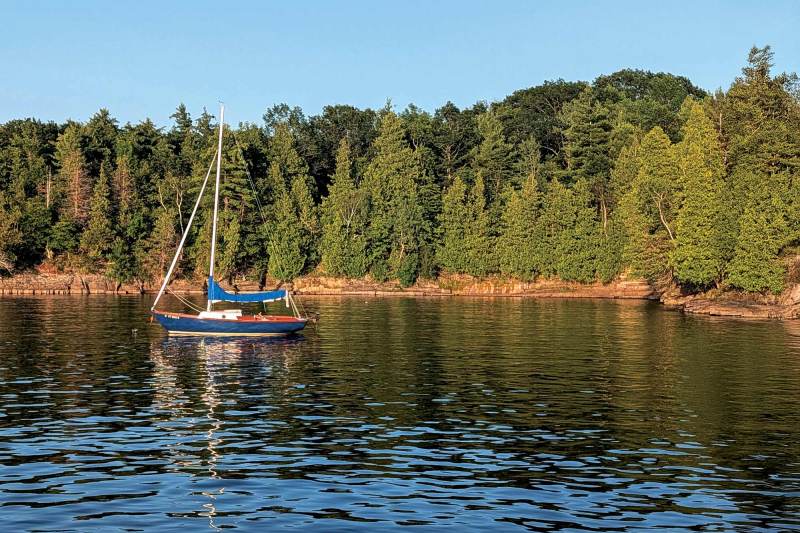 A quiet anchorage.
Lee Ann Smith
That spirit has fueled a long tradition of environmental activism. The Lake Champlain Committee’s list of successes over 63 years include blocking super tanker traffic, stopping a nuclear power plant and requiring boat holding tanks.
The lake came this close to being named another Great Lake in 1998 when President Clinton signed a bill to support lake research. The bill included a single line declaring Lake Champlain a Great Lake, which would have opened the federal bank vault. Midwestern states erupted with slurs that Champlain was half the length of the shortest Great Lake and the smallest Great Lake was 15 times larger than Champlain.
Eighteen days later, Congress excised the line, but not before creating a Sea Grant office, which, along with the Lake Champlain Basin Program, has funneled millions to tackle farm manure runoff and city sewage that creates poisonous cyanobacteria blooms in the heat of summer.
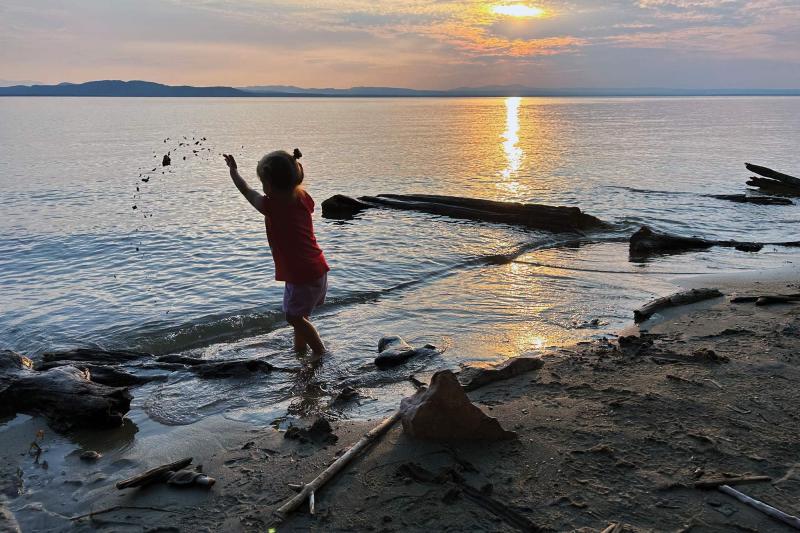 A child plays along the Burlington shoreline at sunset—some things at Champlain never get old.
Jim Carrier
As Vermont’s population has become more diverse, access to the lake is a growing demand. Despite 12 state parks and 100 beaches and boat ramps, most of the shoreline is privately owned. The nonprofit Community Sailing Center on the northern edge of Burlington’s waterfront was launched 32 years ago to provide low-cost boat rentals and sailing lessons.
Every summer, Lake Champlain’s marinas fill nearly all 5,000 slips and moorings, among them scores of Canadians who keep boats on the lake year-round to avoid taxes at home. Waiting lists can be two to three years long.
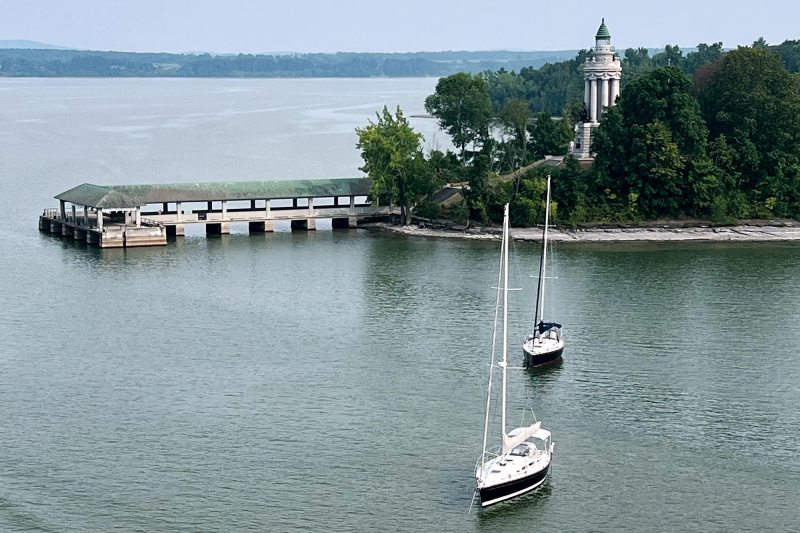 Yacht club boats at anchor off historic Crown Point.
David Main
Vermont sailors, it must be said, exhibit proprietary interest in “their” 450 square miles, an emotion rarely seen among coastal boaters with an ocean to play in. For Vermonters, Champlain is more than a lake. It is a shrine to something timeless and ideal.
The post Lake Champlain and the Battle That Saved a Revolution appeared first on Cruising World.