Satellite Communications for Boaters
 The latest in global satellite communications technology is more compact and affordable than ever, just waiting for boaters to link up and stay in touch.
A.I.-Generated by Adobe Firefly
The latest in global satellite communications technology is more compact and affordable than ever, just waiting for boaters to link up and stay in touch.
A.I.-Generated by Adobe Firefly
Few moments surpass the majestic, surreal wonder of a midnight passage across calm seas on a clear night, far removed from the lights of mankind, where inky water and the atmosphere merge into a singular blackness. Above it all, distant stars, planets and the glowing expanse of our Milky Way illuminate the night sky and touch your soul, a profound reminder that we all are made of stardust.
Yet, today an increasing number of manmade objects also fill the sky. This includes a vast network of communications satellites orbiting hundreds of miles above the Earth. In fact, stare into the nocturnal heavens for any length of time on a clear evening, and chances are better than not that you will see one or more of these satellites tracking overhead. Queue David Bowie’s immortal 1970s refrain, “There’s a star…man waiting in the sky…”.
Chances are pretty good that the satellites you see serve as part of the ever-expanding Starlink communications network.
Today’s StarmanNo matter what you might think of the richest man in the world—Elon Musk, that is—there’s no denying that his Starlink company is revolutionizing satellite communications, not only on land but also on the water. He has done so with a Low Earth Orbit (LEO) satellite network, a shift from traditional geostationary orbiting satellite systems and one that prioritizes higher data speeds and near-global coverage.
With a network that at last count includes more than 10,865 operational LEO satellites launched by SpaceX—one of Musk’s other endeavors—Starlink enables communications using your mobile device or computer virtually anywhere in the world. That’s a very important consideration for boaters who regularly venture outside the coverage area of cell service—including offshore waters.
What’s more, Starlink’s mobile systems eschew the big, cumbersome satellite reception dishes and domes, replacing them with light, compact and portable flat-panel receivers. Further, Starlink receivers do not require complex, power hungry and expensive gyro-stabilization systems, which are common in many conventional marine dome antennas in order to track satellites in heaving seas.
Receivers for Starlink also are far more affordable and require less energy than traditional marine dome antennas, making these systems even more attractive to recreational boaters.
As a result, Starlink has emerged as a welcome—some might argue the only—alternative today for owners of recreational boats as small as 25 feet in length who want to stay in touch—be it with family, friends, business associates or other boaters and anglers—via text, email or voice when cell service no longer works. Boaters also can stream video programming to stay entertained while in a quiet anchorage or guest slip during multiday cruising or fishing adventures.
 The Low Earth Orbit satellite network enables communications using your mobile device or computer virtually anywhere in the world.
Courtesy Elen31/stock.adobe.com
Over Land and Sea
The Low Earth Orbit satellite network enables communications using your mobile device or computer virtually anywhere in the world.
Courtesy Elen31/stock.adobe.com
Over Land and Sea
“I take my Starlink antenna just about everywhere I travel or fish,” says Chris Wheaton, a Southern California resident and businessman who owns three boats and an interest in a vacation home on Mexico’s Sea of Cortez in Bahia de Los Angeles, Baja California Sur. “It covers me when I am driving or boating outside of cell coverage, be it in Mexico or the US, so I am always able to stay in touch with the office and friends.”
Communication between boaters (who are both outside cell range) is possible only if both have Starlink on their boats, Wheaton points out. Yet, your group of boating buddies should give this idea consideration. The advantage to such a collaboration lies in the ability to call your buddy boats in on hot offshore bites or communicate in an emergency.
What do you need to know and buy to get started with a Starlink system? Here are key factors to keep in mind.
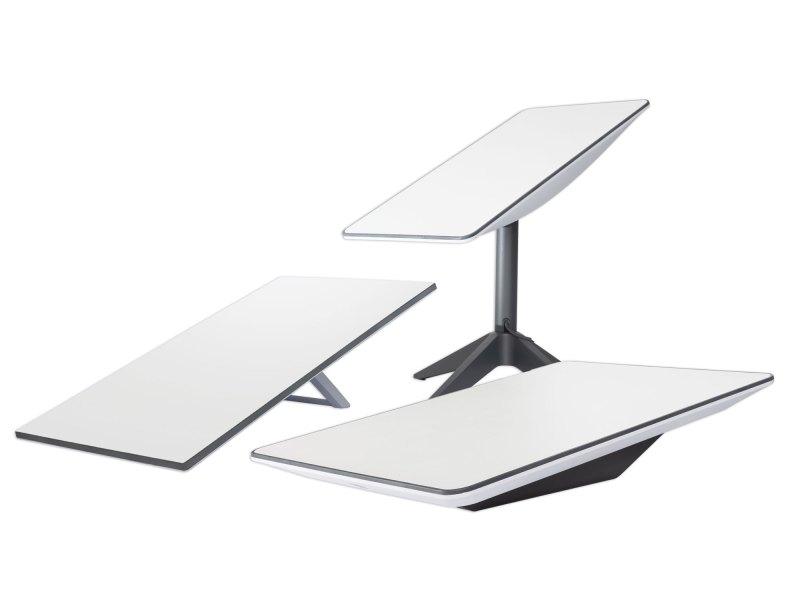 Satellite receivers come in a variety of sizes.
Courtesy KVH Industries
Receiver Choice
Satellite receivers come in a variety of sizes.
Courtesy KVH Industries
Receiver Choice
While there are a number of flat-panel Starlink receiver choices available, the latest to emerge for mobile use is the Starlink Mini ($249; westmarine.com). With an array measuring just 11.4-by-9.8 inches and weighing a scant 2.43 pounds, the Mini and its supplied components can easily fit in a backpack or on boats as diminutive as 25 feet in length. With an unobstructed view of the sky, the phase-array antenna will automatically adjust to maintain a strong and seamless satellite connection, whether you’re charging through choppy waters or running at high speeds.
It’s capable of providing a high-speed, low-latency Wi-Fi connection for up to 28 devices, according to Starlink. However, with heavy streaming, it will support only about three devices. Also, because download speeds are relatively slow, it will not support gaming. Sorry, kids.
Able to operate on 12- to 48-volt DC power, the Mini has an integrated Wi-Fi router and comes with a pipe mount, a kickstand, and all of the cabling you will need. While the Mini is IP56 water-resistant, it is important to use the proper IP67 waterproof cable connectors and plug included with the kit to avoid the intrusion of salt water that can damage the internal electronics.
Mount UpIt’s one thing to use the antenna at a peaceful campsite, but quite another to have it aboard in rolling, pitching, wind-swept seas. You will definitely need some sort of secure mounting system—be it permanent or temporary—to prevent your Starlink antenna from sliding overboard or slamming down on the deck. Thankfully, there are a number of mounting systems available to boaters from brands such as Darkstar, Seaview, Star-Mount and others.
One is the Seaview Starlink Adapter Ratchet Base ($231.20; westmarine.com). You can easily attach and take off the Mini once this mount is installed. Use a cable seal to create a waterproof entry point for the cabling, and make sure the location, such as on a hardtop, offers a clear view of the sky.
Offering that clear view is paramount, as Starlink relies on line-of-sight connectivity between its satellites and the flat-panel receiver. Anything that blocks that line of sight—be it buildings, masts, other antennas or cabin bulkheads—will impede transmission and reception, even with Starlink’s plethora of satellites. Rain, snow and ice on the flat-panel receiver can also interrupt connectivity.
Potent PortableAs indicated earlier, the Mini comes with cabling that connects to the onboard DC electrical system. However, you can dispense with cables by using a portable case with a self-contained power source such as that offered by RoamSat. This system encloses a Mini receiver (sold separately) along with a battery pack inside a 13.5-by-12-by-2.7-inch waterproof case. The great advantage is that you don’t need to drill any holes for a mounting bracket or routing a cable. Plus, you can easily take the Mini on another boat or vehicle.
The 12-volt rechargeable battery offers seven hours of service, and the Mini can send and receive through the top of the polyethylene case. For power, you turn on the switch on the outside of the RoamSat. Weighing under 11 pounds, it is available with four optional high-strength vacuum-suction feet that allow boaters to secure the unit to a hardtop or other flat, smooth horizontal surface. It retails for $1,499 without the Starlink Mini receiver.
Service, PleaseStarlink offers a variety of service plans, but one that’s appealing to many saltwater boating anglers is called Roam. At $55 per month (as of press time), it is the most economical Roam-100GB plan, and it offers “in-motion” capabilities and coverage on land, as well as up to 12 nautical miles off the coast.
The Roam-100GB starting plan provides 100 gigabytes of data per month. That includes up to 300-plus Mbps of high-speed data for approximately one week of typical use, providing “reliable connectivity for occasional trips, camping and getaways,” according to Starlink. You also get unlimited low-speed data after using up the Roam high-speed data.
Once you venture outside of the 12-nautical-mile limit, Roam provides coverage for five consecutive days or 60 days total in a year. “You can also opt for the Roam Unlimited plan that offers unlimited data, but with the same geographic limits as the Roam-100GB plan. It also covers you on land throughout the country, as well as when you travel or boat internationally.
Very importantly, with either plan (as well as the middle-of-road Roam-300GB plan), you can pause and unpause the Starlink service at any time. Billing is in one-month increments, allowing you to tailor the service to your particular fishing or travel schedule.
If you insist on having coverage anywhere on the water and all of the time, you can opt for the Maritime Mobile Priority plan, which starts at $250 per month for 50 GB of priority data per month, offering high-speed in-motion internet on ocean waters and public IPs. It features seamless switching capabilities.
Read Next: Six Affordable Satellite Communications Devices
 SpaceX has expanded beyond launching communications satellites with missions also carrying crew into orbit and the International Space Station.
Courtesy EvgeniyQW/stock.adobe.com
Starlink Monopoly?
SpaceX has expanded beyond launching communications satellites with missions also carrying crew into orbit and the International Space Station.
Courtesy EvgeniyQW/stock.adobe.com
Starlink Monopoly?
Given all of the hubbub surrounding Starlink, you might think that Mr. Musk holds an effective monopoly on the flat-panel LEO satellite communications market. To a large extent that’s true, but there are number of others set to give Starlink some competition, says Paul Comyns of Intellian Technologies, Inc.—a leading satellite communications company in its own right.
“An increased number of LEO satellite providers is expected, with some very close to going live in the next year or two,” Comyns explains. “That will open up the market, stabilize consumer pricing, and broaden service options for 25- to 40-foot vessels.”
One of those companies is Eutelsat OneWeb that operates its own LEO satellite network and already provides low-latency high-speed connectivity worldwide. “However, OneWeb is currently used in more of an enterprise application,” Comyns points out. However, OneWeb’s equipment is compact enough for larger boats and yachts.
Satellite communications for recreational boaters rests on the cusp, poised for change and growth. But for now, Starlink serves as the most viable and robust option for staying in touch no matter where your boating adventures take you, thanks to compact, affordable flat-panel receivers and thousands of satellites waiting in the sky.
The post Satellite Communications for Boaters appeared first on Boating Mag.