Siren Song Of A Catalina 22
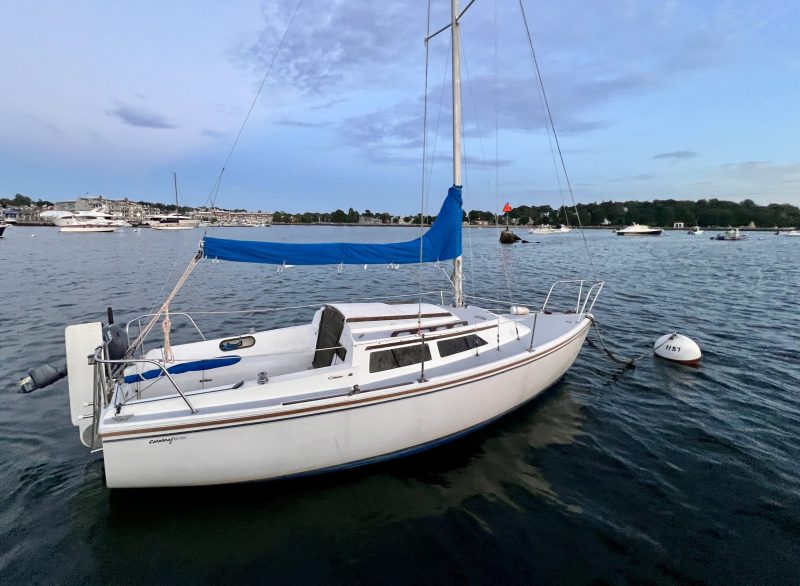 From lawn ornament to vintage mooring candy, the 1986 Catalina 22 floats on its lines.
Dave Reed
From lawn ornament to vintage mooring candy, the 1986 Catalina 22 floats on its lines.
Dave Reed
My web browser knows perfectly well what I’ve been up to, and the algorithm is now screaming “Catalina 22” into my feed. This means that I’ve done something stupid and bought a boat. A project boat, nonetheless. So, yes—I’ve joined the club of wide-eyed, shallow-pocketed sailors who see an old boat on a trailer and think, “doesn’t look too bad.”
And here we go.
Long story short: Here in Newport, Rhode Island, there’s a simple use-it-or-lose-it mooring ordinance, so for the past year I’d been on the hunt for an inexpensive trailerable 20-footer that would scratch my itch for overnight bay excursions and local beer can racing. I can’t afford the ridiculously high winter storage fees, so I needed something I could haul myself and store in my driveway.
A chance and casual conversation at the yacht club bar this past winter led me to an owner who was eager to rid herself of a lawn ornament. The price was right, and with the tarp pulled back, this 1986-vintage Catalina 22 looked promising on the outside. Once the squatting hornets were exterminated with a jet of insecticide, the inside didn’t look half bad either. There wasn’t a lot of water in the bilge, thankfully. Compared to other Facebook Marketplace deals that tempted me, this one had real potential. Plus, the boat came with a 20-year-old Yamaha 4 horse outboard and vinyl cockpit cushions. The trailer was decent. Sold.
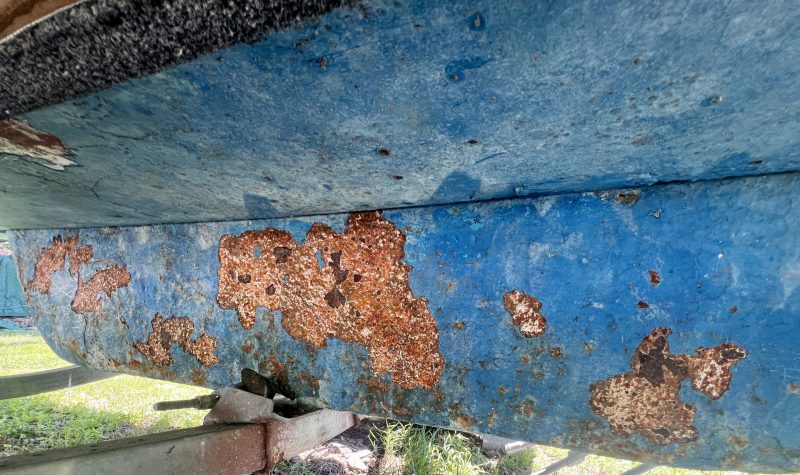 Many grinding and sanding hours later, the boat’s iron swing keel–at least what was accessible on the trailer—was burnished to “good enough.”
Dave Reed
Many grinding and sanding hours later, the boat’s iron swing keel–at least what was accessible on the trailer—was burnished to “good enough.”
Dave Reed
But what gave me restless nights after a handshake with the seller was the state of the boat’s 600-pound iron swing keel: rusted, pitted and bleeding though its bottom paint. That, I knew, would be the first installment of my sweat equity. As I was crawling in the dirt below the boat, trying to assess how bad it really was, the owner kept telling me to not worry about…“just put the boat in the water and enjoy it.”
Not a chance, especially given the warnings and words of caution on the online forums. This particular boat has a bronze pivot pin, held fast to the hull by bronze hangers bolted to the hull astride the centerboard slot. Connected to the trailing edge is a stainless-steel winch cable, which disappears into the hull. Like the pivot pin, this cable connection is a popular cautionary theme online. Without knowing the maintenance history of the boat, and doubtful the owner did much preventive care, I knew these pitfalls had to be dealt with immediately. But with the boat on its trailer I did the best I could with an angle grinder and 80-grit to get to bare metal. It was a nasty, dusty and dirty job indeed, made worse by the cramped workspace of the trailer.
I got it to a point that was “good enough,” and because I didn’t have the time nor the equipment to extract the keel and inspect the pivot bolt or lift cable connection, I accept that I will have to live with good enough. That’s unnerving, because, when it comes to boats, we all know good enough is never enough. It erodes all confidence when pounding upwind into steep chop.
With the bottom sanded, bare spots epoxy primed, and ablative paint rolled on, the in-water part of this project was complete. Now to the interior. And here again, the online chatter of this particular model has red flags about the forward bulkheads that anchor the top-shroud chain plates. Look for rot, many warned. And indeed, my stomach dropped when my finger poked through moist wood. A sure sign that both through-deck fittings were leakers.
“Oh,” the owner rejoiced when I pointed it out, “that’s where the water was coming from.” While not ideal and a touch unnerving, I had to punt this major project until the winter. The priority was getting the boat its mooring to ensure I didn’t lose it forever. A thorough cleaning and bleaching got the interior happier. A generous squeeze of 3M 4200 to the chain plate deck fittings would get me through the rest of the season.
Continuing to work from the bottom up, next came the rig, which was in good shape. All the shrouds looked sound, save for a few tweaked turnbuckle T-fittings, which apparently bend easy when the deck-stepped rig is raised from a crutch. There are dozens of deck fittings for shrouds to catch on Catalina 22 forum regulars advise. I concur.
And before the trailer was going anywhere near a road, having sat for the better part of two years, I loaded the bearings with grease, replaced the broken tongue jack and hit the rust spots with an inhibitor.
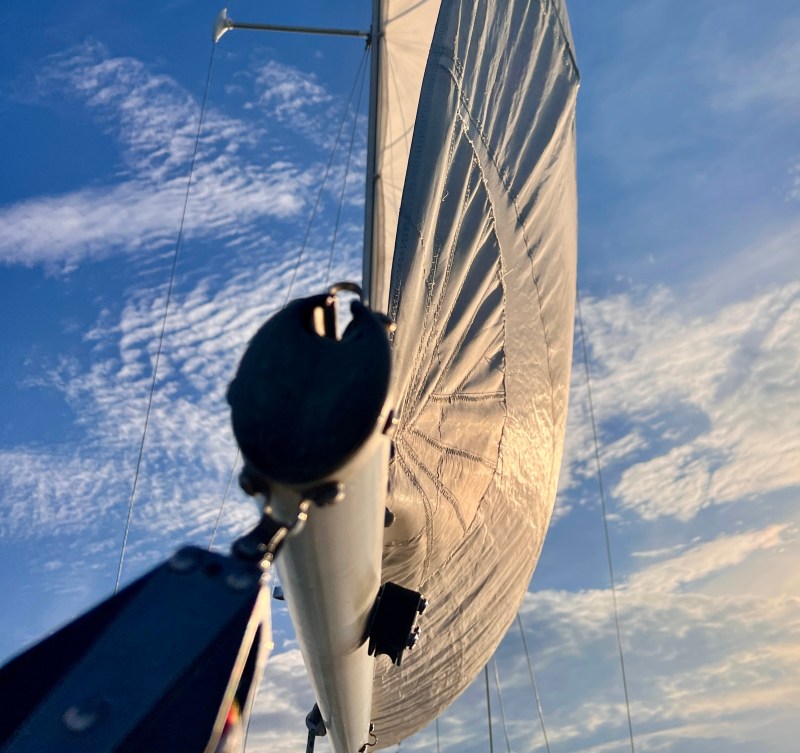 Plenty of depth in the old sail that came with the project boat, with seams straining from the load of a light-air stress test.
Dave Reed
Plenty of depth in the old sail that came with the project boat, with seams straining from the load of a light-air stress test.
Dave Reed
But now the sails. The owner extracted from her garage the boat’s original sail bags and pulled out what should have been drop cloths for the bottom job. The original sails with the “Catalina Sails” logo near the tack fitting were indeed 40 years old. I’ve never felt sailcloth so soft and supple. The snap hooks on the 110-percent jib were corroded shut, and it’s a miracle the stitches remained. But for now, these too qualify as good enough.
The outboard, which the owner promised would start on the first try, was no dice. I was seriously tempted to drop it off at the local Yamaha dealer and bend over. But on the advice of my son, I agreed to carefully deconstruct the engine to troubleshoot it: air, fuel, spark. None of which did the trick, so he extracted the carburetor, and with the assistance of ChatGPT, cleaned it in minutes. It was his first attempt at outboard repair, and with a shot of starter fluid, that sucker kicked over on the first pull and ran beautifully in the bucket. AI for good.
With my launch deadline approaching, and finally a window to do the deed, we did indeed launch it on August 1. The first sigh came when it didn’t sink at the dock. The second was motoring, and the third sigh was the swing keel lowering without falling out of the boat. The final exhale was the boat bobbing on its mooring, Harbor Master approved.
The on-water worklist then turned to the standing and running rigging. Following the North Sails tuning guide, and using a Spinlock RaceSense gauge, I got it standing as straight as I could and recorded my first “base settings.” I eagerly spliced and ran a new main halyard and mainsheet to replace the brittle UV-baked originals.
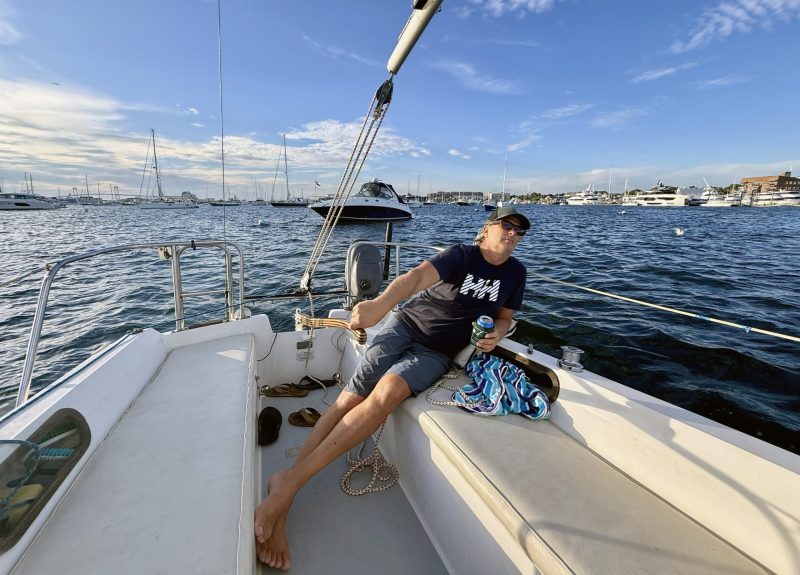 CAPTION: Stress testing the Catalina 22 rigging and checking its upwind angles under main alone, the author takes his project boat on a maiden harbor cruise.
Dave Reed
CAPTION: Stress testing the Catalina 22 rigging and checking its upwind angles under main alone, the author takes his project boat on a maiden harbor cruise.
Dave Reed
The jib halyard would come eventually, but first, its maiden sail, under main alone, to confirm the rig tune, and get a sense of the Catalina 22’s tacking angles. With the sail set, stains and small tears aside, I got a good chuckle when I eyed its shape from behind the leech. It is the softest and most billowy sail I’ve ever trimmed. It got us to and from the mooring, but it’s bound for the sail recycle bin, ASAP. Same for the jib, its leech all a-flutter and the deep sags between hanks that no amount of halyard tension could remove. But, hey, the boat “sailed” and even fast enough at times for the keel cable to “sing.”
I admit, however, to web searching “Catalina 22 swing keel hum” once back on the mooring…just to be sure it wasn’t a sign of the keel pin or wire failing. That’s “good-enough paranoia.” Thankfully, with the Catalina 22 in existence for more than half a century, and more than 15,000 of them built since the 1960s, there’s plenty of insight, lessons, fixes and pointers out there on the web. And better yet, a long-running ecommerce operation called “Catalina Direct” has all the parts I need.
I’m a long way off from applying for a PHRF certificate or even thinking about one-design racing, but this much I know—while the leap of faith into a project boat is a big one, the baby steps to getting it dialed in, one thing at a time, is oddly enjoyable. It’s worth the satisfaction of a perfectly balanced helm and a boat that we can confidently put to new adventures.
And so they begin.
The post Siren Song Of A Catalina 22 appeared first on Sailing World.