The Basics of Pitch-Baiting
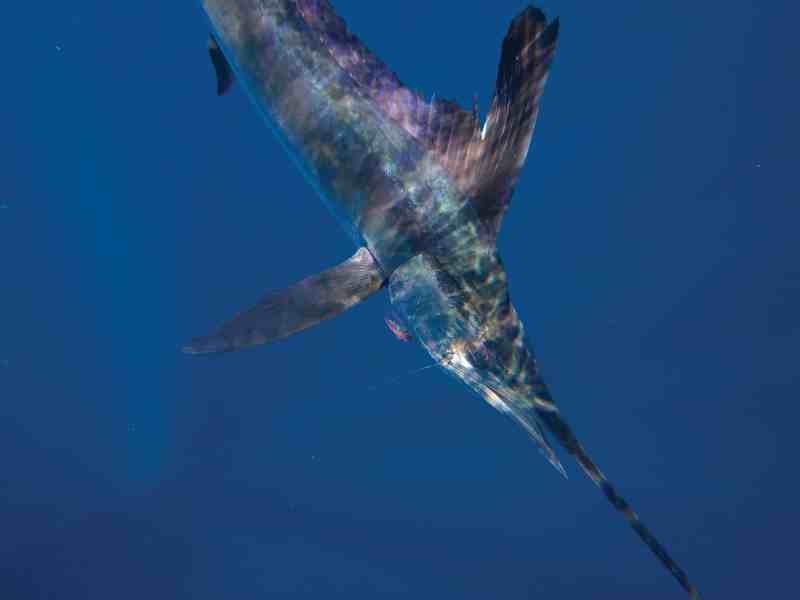 Pitch-bait techniques can work well when targeting white marlin, sometimes converting a single hookup into a double or triple.
George Poveromo
Pitch-bait techniques can work well when targeting white marlin, sometimes converting a single hookup into a double or triple.
George Poveromo
A mix of dredges, daisy chains and a staggered ballyhoo spread depicted a life-rich swath of ocean behind Capt. Russ Kostinas’ Top Notch. White marlin was our goal that day off Virginia Beach, Virginia, and they surely were fooled by the well-orchestrated illusion.
Dr. Ken Neill III scored first with a round-scale spearfish. Then the whites showed. In one instance, Ken was fighting a white when another appeared behind the starboard daisy chain. I free spooled a ballyhoo, got it splashing, and teased that fish into striking. Now we had a double header in the works. It was a wild scene.
Virginia and Maryland’s offshore waters are primed for pitch baits in August and September during the peak white marlin run. Yet, pitch-baiting is far from exclusive to the Mid-Atlantic. For example, this same white marlin migration rounds the far eastern Bahamas in April and May; we’ve successfully pitch-baited them well offshore of the Abacos’ Green Turtle Club. When they migrate beyond Virginia and Maryland, Northeastern offshore anglers score with the “tease-and-pitch” routine. Pitch-baiting is dominant in numerous regions when migrations of sailfish, white marlin, blue marlin, and even swordfish are at their highest.
Here’s the PitchPitch-baiting, whether practiced exclusively by dragging just teasers and dredges (no trolling baits) or with a full trolling spread, has major advantages. Firstly, any fish coming onto a dredge or teaser is typically charged up, and the more a teaser is kept from it, the more aggressive the strike becomes (read: fewer window shoppers). Secondly, successful hookups rise dramatically when fish are baited close to the transom, credit less line stretch. Furthermore, an angler can view the take and determine the optimal striking angle (sideways to or heading away from boat). For tournament anglers in particular, up-close hookups make for swift releases and less stressed fish.
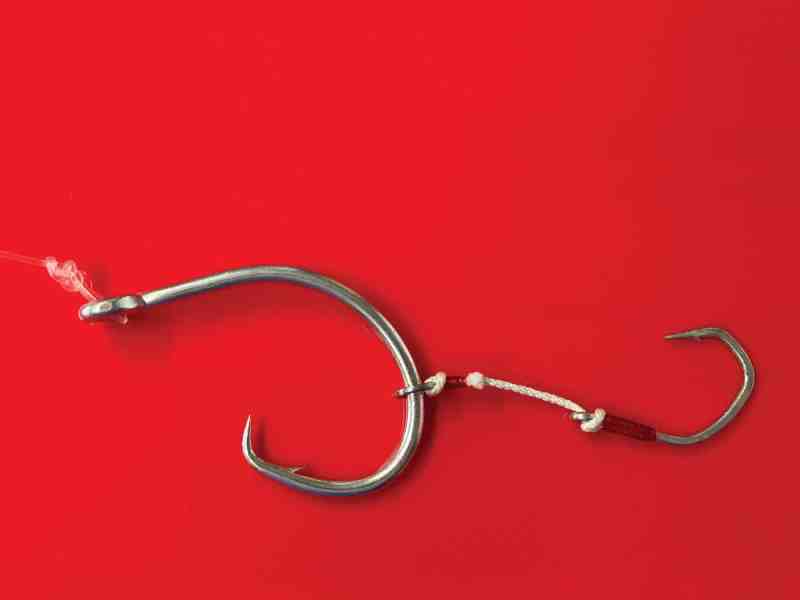 The quick pin rig lets you easily rig a small mahi as a pitch bait when a blue marlin crashes the spread.
George Poveromo
Pitch Tackle/Baits
The quick pin rig lets you easily rig a small mahi as a pitch bait when a blue marlin crashes the spread.
George Poveromo
Pitch Tackle/Baits
For sailfish and white marlin, 20- to 30-pound class gear, a small to medium circle hook, ballyhoo or strip bait, and 50- to 80-pound-test fluorocarbon leader is the norm. For blue marlin, a 50-pound class outfit with a circle hook and a large/horse ballyhoo on 200-pound-test fluorocarbon leader is a popular set up. Obviously, tackle class, leader strength and even pitch baits are based on region and predominant size of fish.
Off the Bahamas, for example, we’ll keep ready a large 20-pound class spinner and small 30-pound class conventional pitch-bait outfit for sailfish, whites and mahi; we’ve caught whites off Green Turtle on spin tackle.
For blue marlin, we’ve got a 50-pound class outfit ready. We also keep one rigged for quick deployment of a mahi, should a blue marlin crash at the surface or appear when we’re into a school of mahi. The “quick pin” rig is simply a large circle hook with a flutter-jig assist hook attached to it. Just pin the small assist hook into a mahi’s upper jaw and send it out. The circle hook remains in front of the bait, ready for business.
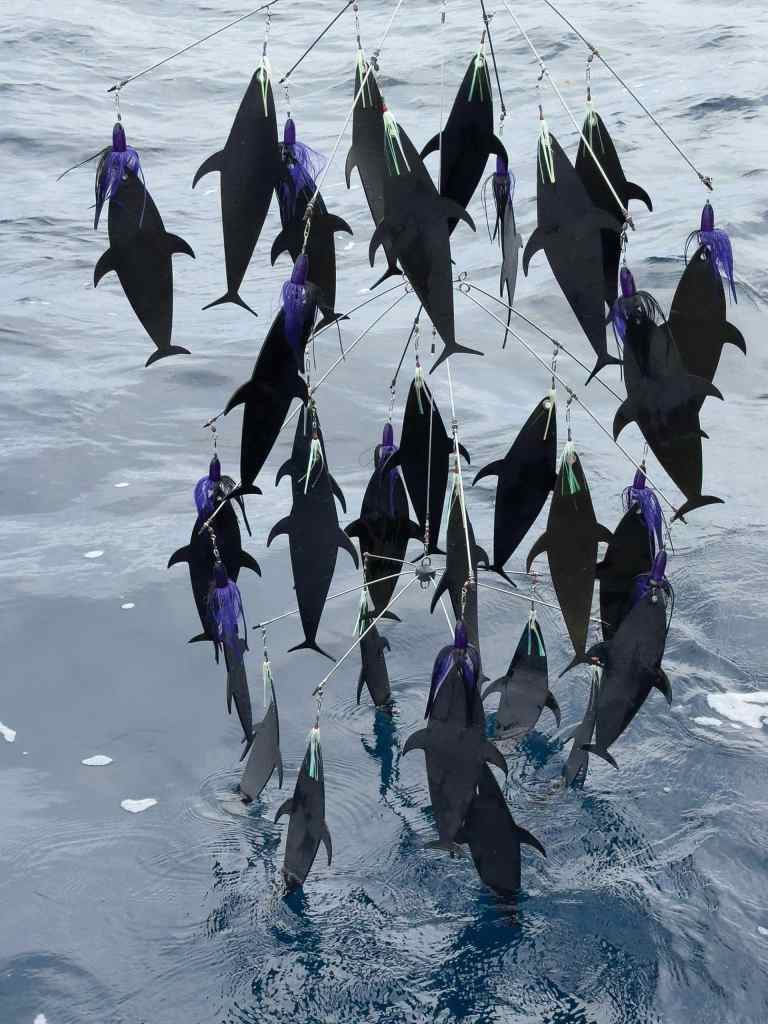 For dredge fish, pitch a bait just ahead of the unit and free spool. The take should be instantaneous.
George Poveromo
Pitchin’ Skills
For dredge fish, pitch a bait just ahead of the unit and free spool. The take should be instantaneous.
George Poveromo
Pitchin’ Skills
Keen eyes and quick reactions are needed for spotting fish in the spread or stalking a dredge. Forethought and precision are also required when pitching a bait from a center console or even aboard a large sportfisher brimming with tackle, hardtop and outriggers. Underhand casts best avoid boat hardware, trolling lines and baits.
For dredge fish, pitch a bait just ahead of the unit and free spool. The desired illusion is that of an injured bait drifting back and down from the school. The take should be instantaneous. If not, skip the bait back in front of the dredge and free spool again. Just be aware to avoid tangling with the dredge set-up.
With a surface teased fish, pitch a bait back to the teaser, which should now be in full retrieve mode. Get the bait skipping and coax the fish onto it. Manipulating game fish off surface teasers is highly visual and beyond exciting.
Hook SetFor billfish, circle hooks are the norm. Aim the rod tip at the fish, slowly advance the drag and begin lifting the rod as the fish is running off line. Avoid fast and aggressive sets, where, on a miss, a bait may land yards away from the fish. A slow-set miss will likely keep a bait within a few feet in front of the fish, still in prime striking position.
Read Next: Tips for Successful Pitch-Baiting
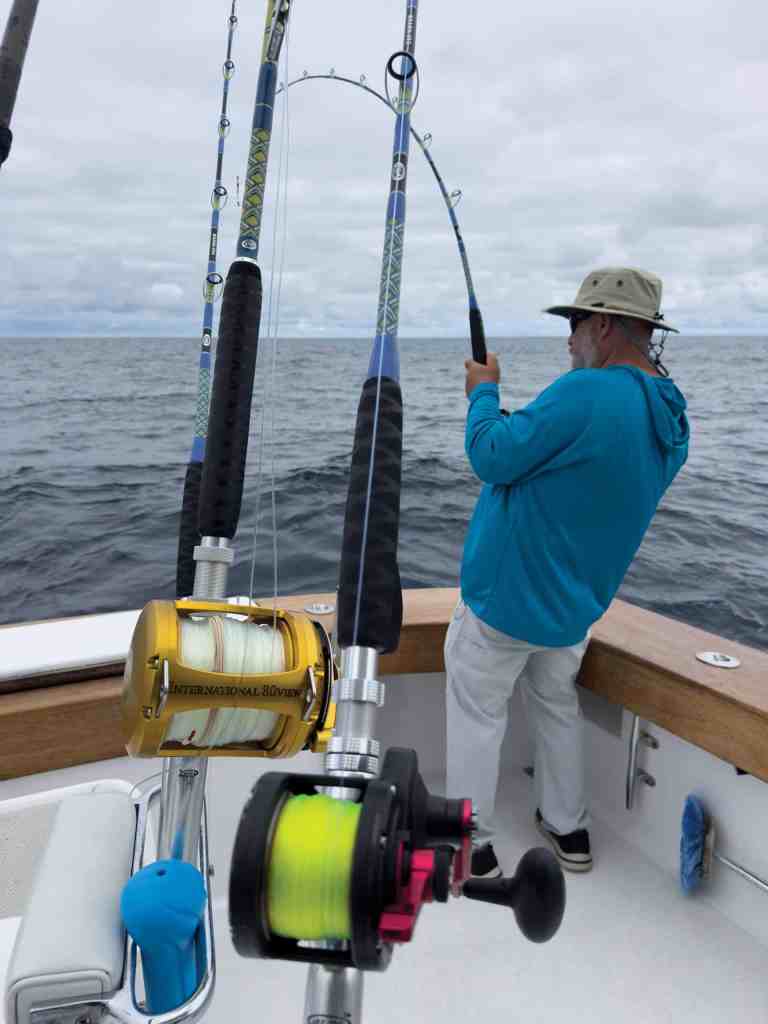 Anglers need to be alert and agile when pitch-baiting amid a cockpit full of tackle and a full spread.
George Poveromo
Double Down Pitchin’
Anglers need to be alert and agile when pitch-baiting amid a cockpit full of tackle and a full spread.
George Poveromo
Double Down Pitchin’
Whites, sails and other pelagics travel in pods and pairs. When fighting a billfish to within casting range, have a second angler pitch a bait behind the hooked fish, but avoid tangling lines with the hooked fish. It’s quite possible to double up with a companion fish; if successful, pitch a third bait behind that one. “Prospecting” is an excellent way to drive up numbers in tournaments, especially with sailfish.
The Fun FishWe’ve had school mahi zero in on daisy chains, after devouring our trolling spread. Rather than stop and catch them, engage the autopilot and keep the boat slowly moving forward. In Pied-Piper fashion, those mahi sometimes follow the daisy chains.
Pitch a bait behind the daisy chain, hook a mahi, and move to mid-ship so another fish can be hooked. Boat the mid-ship fish, get back in line, recast, hook another, and repeat the tactic. Dragging daisy chains is effective for keeping mahi with you when they’re reluctant to pause for a stopped boat.
For blackfins and yellowfins hooked on the troll, drop down a deep jig or flutter-style iron, weighted live bait, or ballyhoo for followers.
It all comes down to how much effort you want to invest in loading the fish box.
The post The Basics of Pitch-Baiting appeared first on Salt Water Sportsman.