Chesapeake 20 Racing: the Iconic West River Tradition
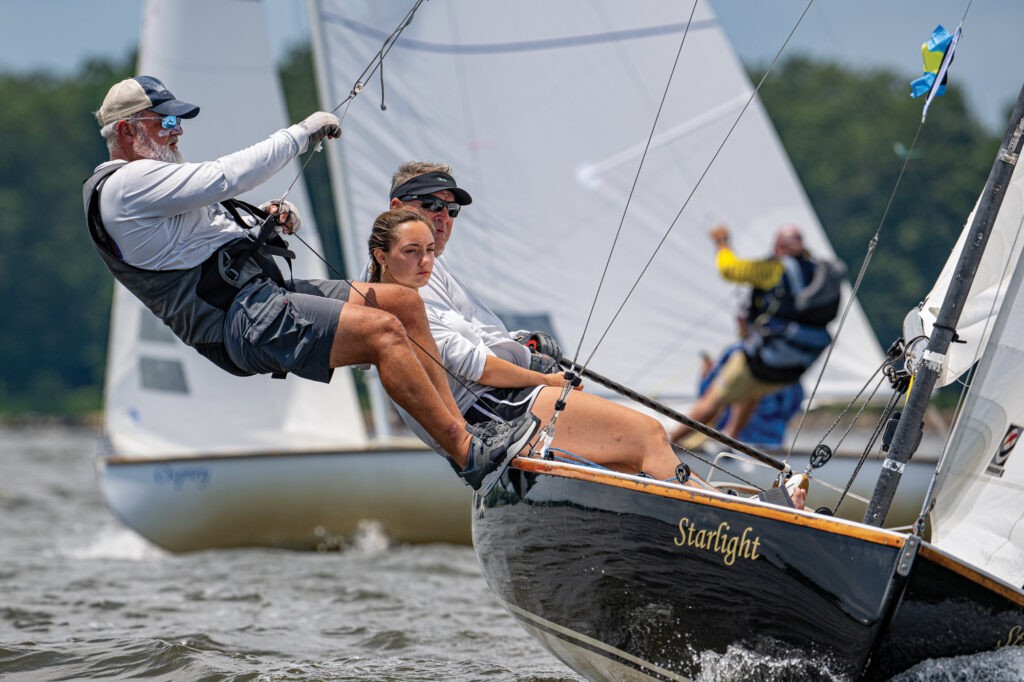 Alex Shafer (helming), Daphne Clancy and Jero Tudor lead the fleet at the Chesapeake 20 World Championship in West River, Maryland.
Walter Cooper
Alex Shafer (helming), Daphne Clancy and Jero Tudor lead the fleet at the Chesapeake 20 World Championship in West River, Maryland.
Walter Cooper
At the West River Sailing Club in Galesville, Maryland, there are plenty of options when it comes to racing classes, but the one that has held high court since the early 1930s is the homegrown Chesapeake 20. There is no equal to it anywhere in the world, but that’s because—with the exception of a few runaways—they don’t exist anywhere else. It’s a West River thing.
This summer’s Chesapeake 20 “World Championship,” contested on the same skinny waters for which the tippy 20-footers were originally designed and built by Ernest H. Hartge, had seven compete. Some were fiberglass, some wooden, and there was plenty of color and colorful local characters, with a few sailors as old as their boats. There were a few days of river racing, and after it was all sailed and done, skipper Alex Shafer, from Eustis, Florida, and his crew of Jero Tudor and Daphne Clancy emerged as the new world champions.
The country Shafer chose to represent was the Bahamas, and, naturally, his contribution to the regatta’s dinner party was conch fritters.
The biennial regatta is not technically a world championship, and Shafer is not Bahamian, although his family has owned property there since the early 1900s. And while he’s got Florida tags on this truck, his roots run wide and deep in Galesville—to the Hartge family and its historic yacht yard. That too is a West River thing, where everyone, it seems, is six degrees related to the Hartges.
Shafer’s abbreviated version of the class takes us back to Grandpa Hartge’s first hard chine hulls, built by hand and eye. It was a development class at the outset, but once rounded hulls arrived and proved to be faster, that was that, and that is where the class is today. “Chesapeake 20 racing was their pastime, their weekend,” Shafer says. “This was their NASCAR. You had workboat people, oystermen, crabbers, and eventually the businessmen would come and buy boats from my grandfather. For them, it was competition, to go out and see who had the fastest boat.”
Hartge’s boatyard built the vast majority woodies, 40 or 50, Shafer reckons, until a mold was eventually built, ushering in a fiberglass generation in the 1980s. Some of the earliest 20s are in museums, and scant others are scattered around the continent, but at West River today, there’s about 20 boats in various states of care. Shafer owns three: one cold-molded model, the very first fiberglass boat, and one of his grandfather’s originals, Columbia, built in 1939.
Shafer, like other West River sailing kids who group up on, around and were mentored in the Chesapeake 20 fleet, has been more active with the class of late, partly because of a renewed interest in racing them and a younger generation of post-collegiate 20-somethings getting in on the fun. Rob Hoffman, runner-up to Shafer at the Worlds, is new blood, as is Charles Anderson, the youngest hot shot in the fleet.
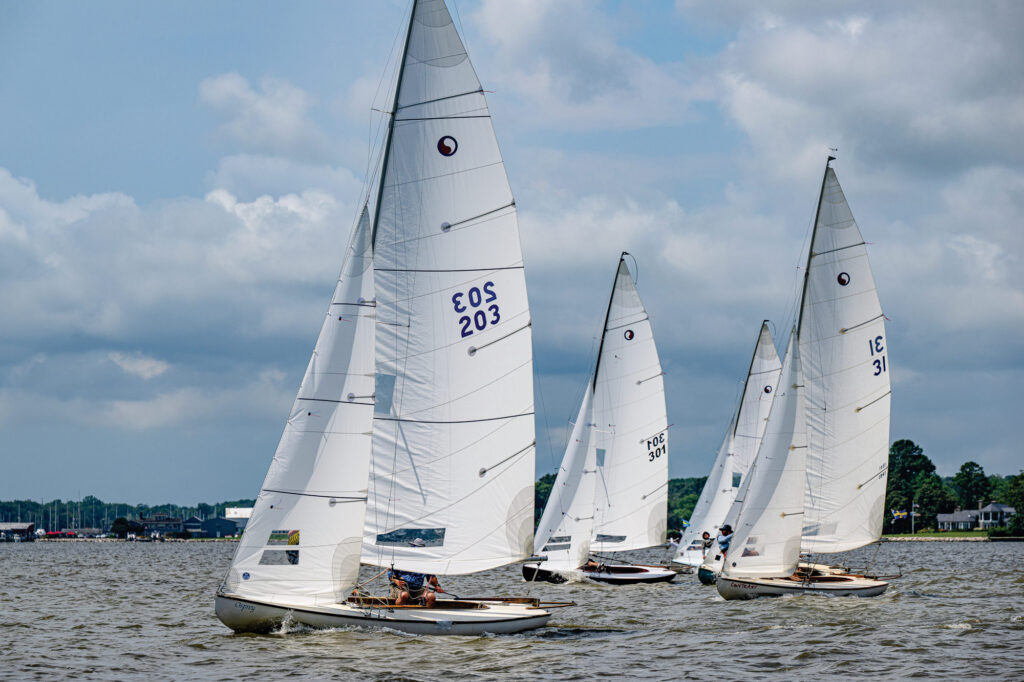 Only seven sailed this year’s Chesapeake 20 Worlds, but there are plenty more at West River Sailing Club.
Walter Cooper
Only seven sailed this year’s Chesapeake 20 Worlds, but there are plenty more at West River Sailing Club.
Walter Cooper
At the Worlds, “Robert was schooling all of us from just hopping on the boat,” Shafer says. “He came out firing and scared us at first. I think he sailed on the boats as a kid a couple times, so he was familiar with it, and just like everyone else there, there’s some sort of connection to it, either by family or by legacy of living in West River.”
Anderson, a 22-year-old professional coach and St. Mary’s College sailing team alumnus, had to miss the recent Worlds for work, but he, too, is deeply rooted. As an eight-year-old, he was omnipresent around the sailing club and the various Hartge workshops. “All these guys are like family,” he says. “They’re all my uncles at this point.”
When Anderson was 13, a member of the club who had passed away willed his Chesapeake 20, Four Aces, a 1960s woodie, to someone young from the club that would keep it sailing competitively and Anderson’s family happily took ownership. “It’s a good-looking red hull with cool racing stripes,” Anderson says, “but it’s old and needs a lot of work.”
While Anderson and his father got to work on Aces they bought a fiberglass hull boat from the 2000s.
And when he was sixteen, Anderson raced the Worlds with Roger Link, whom he considers to be his sailing mentor. “He was 70, out on the wire, ripping it,” Anderson says. “He’s an incredibly talented sailor that taught me how to race.”
They won the Worlds that year, entered as Swedes, making Anderson the youngest skipper to ever win it. They were supposed to bring Swedish meatballs to the party, but that never happened.
Hartge’s Chesapeake 20 was designed for the lighter summer winds of the Chesapeake, and is therefore absurdly over-canvased—thus the trapeze, which was added in the 1970s. Fourteen knots of breeze, Anderson says, is pretty much the top end of control for the boat.
“It’s a very shallow and round bottom hull with a centerboard that’s about 250 pounds, and the rudder is quite small, so there’s a tremendous amount of weather helm,” he says. With a Star Class-type mast and 250 square feet of sail area, Anderson says, “trimming the main is kind of a beast and you’re fighting the tiller the whole time. If you ever have a neutral helm, you’re doing something wrong. But if it’s flat water, it’s beautiful. When you get up to 7 knots, it’s a blast.”
In as little as 7 knots of breeze, depowering is definitely required, Shafer adds, and one would be wise to keep the mainsheet readily at hand to dump when necessary. Two to three crew is the norm, but class rules allow up to five. “I don’t know where you’d put them all,” Shafer says, “but when I was a kid we used to race with four or five of us.”
Downwind, with the whisker deployed, Anderson prefers his crew standing up by the mast, like Star crews do. Sailing tighter angles, he says, is his preferred technique. Jumping on powerboat wakes is fast. “I sail a little bit more aggressively downwind than the majority of the fleet, coming from a dinghy background,” he says. “It’ll plane if you have enough breeze, but it is quite scary.”
While still a development class, there’s not much left to tinker with these days, Shafer says. Advantages can still be explored in the foils and mast tune (although Anderson admits to not adjusting his much, if ever). What’s more important is how one presents the boat to the wind, and managing the wackiness of river racing. “You better be on your shifts,” Shafer says, “plus, we have current and there are really, really good sailors at West River.”
At its peak, the world championship fleet had upwards of 20 boats and while it remains a core class at the club, turnkey boats are harder to come by. Fixing up the old woodies takes commitment, but when a good one comes along, it’s promptly claimed. “Everybody in the club respects the class and understands its history,” Anderson says, “and everyone also recognizes that the sailors that are still sailing these boats have sailed them since they’re probably 10 years old. There’s a lot of legend and lore around it.”
Anderson owns a Laser and a Snipe, as well, but his Chesapeake 20s are more than boats in the family fleet. “I don’t think I would ever want to get rid of them,” he says. “They’re just beautiful boats, and it’s great to be a part of it. It’s kind of my favorite, and I’m excited to keep the class going and bring new people into the class.”
The post Chesapeake 20 Racing: the Iconic West River Tradition appeared first on Sailing World.