Choosing Props When Running Multiple Outboards
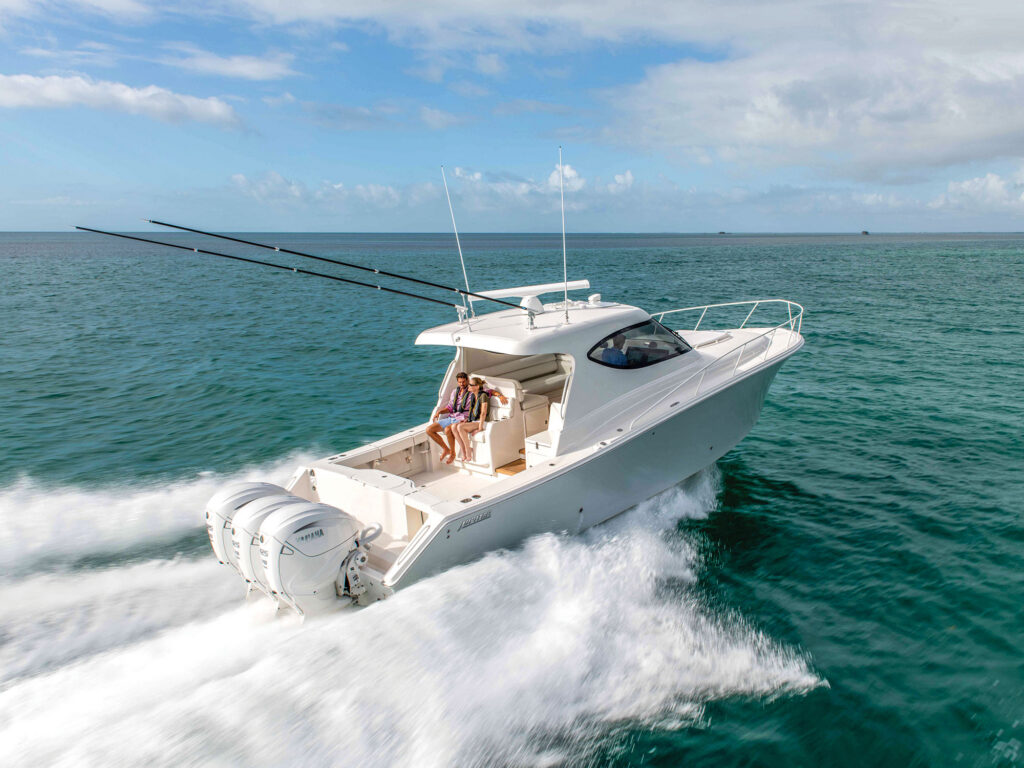 This Jupiter 41 SB is running fine not only because of its captain and trim control, but because of expert selection of propeller characteristics and rotation.
Courtesy Jupiter Marine International
This Jupiter 41 SB is running fine not only because of its captain and trim control, but because of expert selection of propeller characteristics and rotation.
Courtesy Jupiter Marine International
Propellers affect more than speed and fuel economy. In fact, the more outboards there are hanging on the transom, the more propeller selection dictates a boat’s ride, minimum planing speed, and dockside agility. Boating reached out to several experts to get you these guidelines for choosing props to optimize performance with multiple outboards.
Boat Balance and Propeller LiftMore engines can weigh down a boat’s stern. “We want to pick up the stern and run the boat on the lines it was designed to run on, and let the fine entry of the bow cut through the waves,” says Marcus Clements, vice president of PowerTech! Propellers.
Rather than forcing the bow down with engine trim, propeller blade shape can generate lift, not just forward thrust. That elevates heavy sterns. The opposite—too much weight forward—can grab the water and “steer by the bow,” and trimming motors to lift a heavy bow might make a boat “porpoise.” Either way, Clements manipulates lift by choosing from among the company’s 3-, 4- or 5-blade props available in many designs through all common pitches. Those balanced boats perform better across a wider range of speeds and sea conditions.
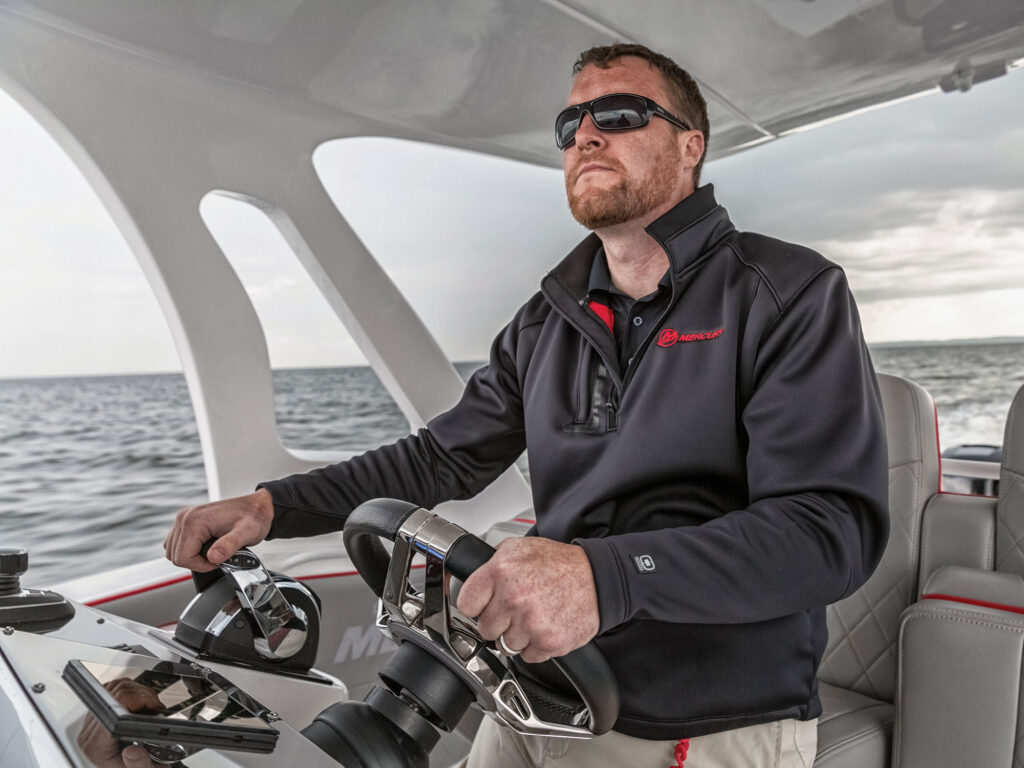 Intentional and well-thought propeller selection choices can result in a boat that has both better handling and delivers superior performance.
Courtesy Mercury Marine
Multi-Engine Interactions
Intentional and well-thought propeller selection choices can result in a boat that has both better handling and delivers superior performance.
Courtesy Mercury Marine
Multi-Engine Interactions
How props interact also changes balance. Back in 1989, Jupiter Marine’s inaugural 31-footer was a big boat for outboards. Jupiter chose props that turned inboard, with a left-hand prop rotating counterclockwise (viewed from the stern) on the starboard engine, and vice-versa. That rotation pushes water down, between the engines, rather than drawing it up from beneath the keel.
“Inboard rotation gave us more stern lift to carry more weight aft from a big fishing crew, multiple livewells and loaded fish boxes,” says Todd Albrecht, Jupiter Marine president. The balanced boat also achived faster speed and burned less fuel.
For most boats, traditional outboard rotation for twins or trips avoids ventilation issues and quirks in dockside maneuvering. Things take a turn with quads, though, where the two outermost propellers can rotate outwardly, while middle engines turn inboard. “Big, wide hull designs see less net results from that experimentation,” Albecht says. “But for a boat that needs to run with a lot of bow-down trim, inboard rotation for the inner two outboards with quads can fix that quickly.”
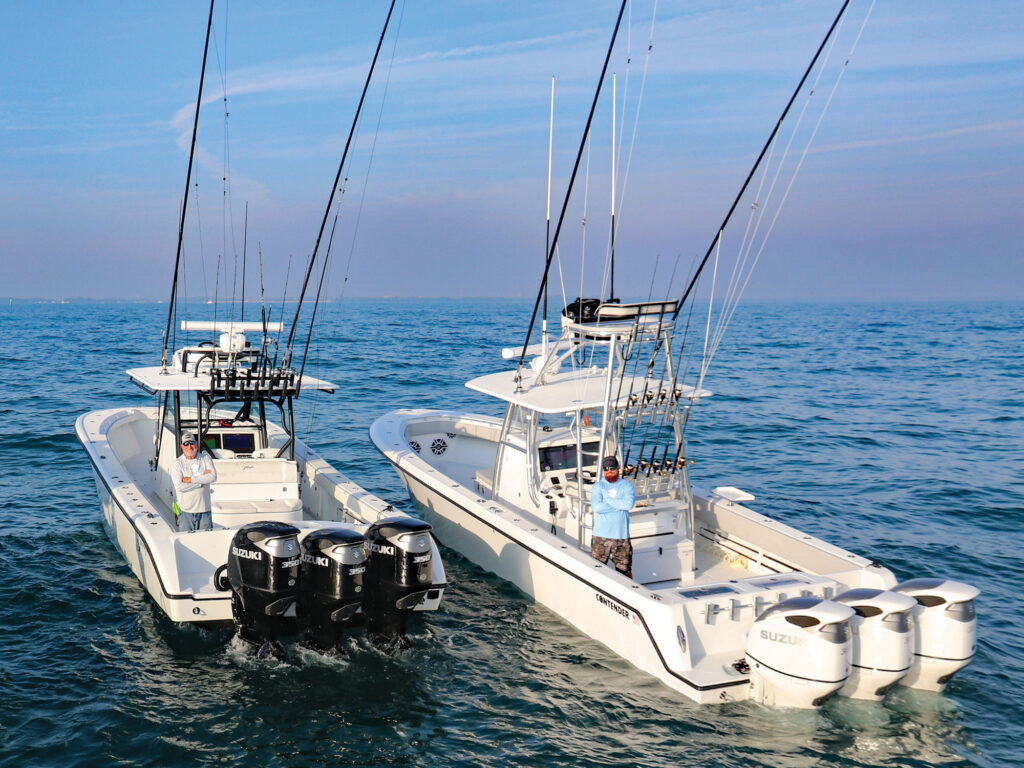 As these Suzuki-powered outboard boats show, multiple outboard-engine installations can feature variable engine mounting heights (black) or variable shaft lengths (white). This is a result of changing draft as a result of a deep-V hull’s transom deadrise.
Courtesy Suzuki Marine
Engine Mounting Location
As these Suzuki-powered outboard boats show, multiple outboard-engine installations can feature variable engine mounting heights (black) or variable shaft lengths (white). This is a result of changing draft as a result of a deep-V hull’s transom deadrise.
Courtesy Suzuki Marine
Engine Mounting Location
Adjusting engine height and spacing also yields gains. “Props have to be deep enough in the water to maintain bite and not blow out in turns or in rough seas,” says David Greenwood, a department manager at the Suzuki Marine Technical Center. “At times a good 4-blade prop can allow for a little more elevation,” he says, which plays a role in both speed and draft.
“For us, trips almost always have a larger prop in the center,” Albecht says of Jupiter models that offer the choice of twin, triple or quad power. “You either mount the engine deep enough that the prop doesn’t slip, or just deep enough so the next higher pitch hooks up well on the hole shot.” On the other hand, Jupiter specs four identical props across most quads.
Engine spacing yields similar affects. “Engines mounted further apart give you shallower draft and better dock handling, but it’s slower,” he says.
Read Next: Comparing Three-, Four-, and Five-Blade Propellers
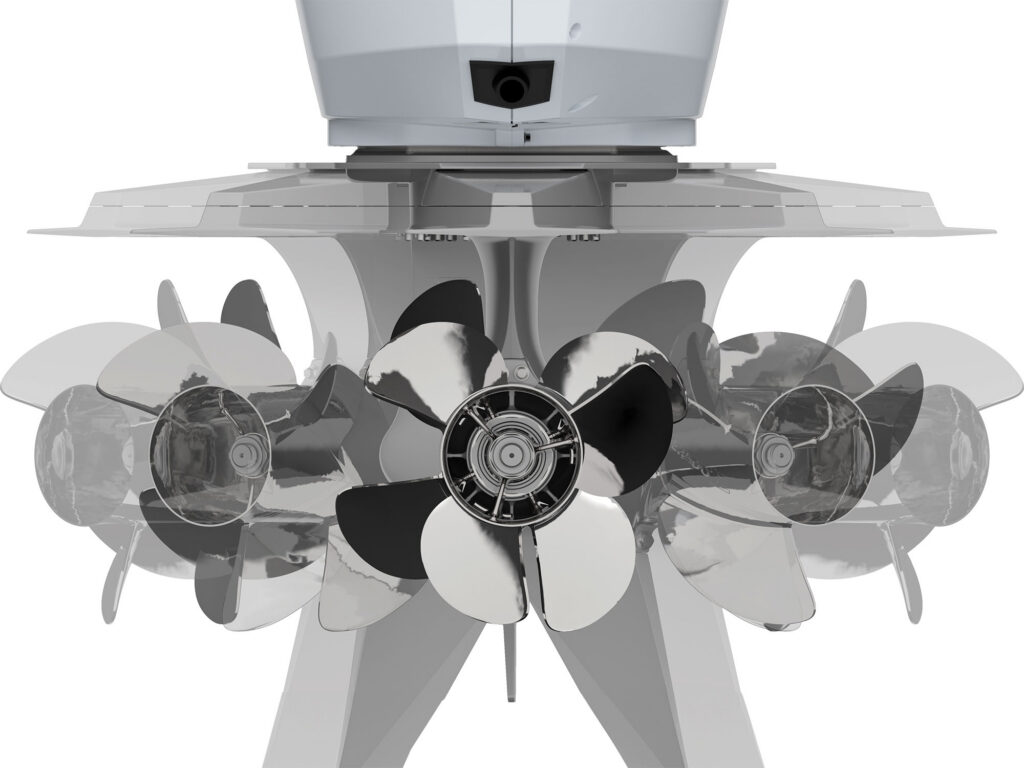 Contra-rotating propsets (as shown here on the rotating gear case of a 600 hp Mercury V-12 Verado) present another variable in propping.
Courtesy Mercury Marine
Doubling Down
Contra-rotating propsets (as shown here on the rotating gear case of a 600 hp Mercury V-12 Verado) present another variable in propping.
Courtesy Mercury Marine
Doubling Down
By distributing each engine’s torque over two propellers rotating in opposite directions, contra-rotating propellers bite the water twice as well—typically 4 to 6 percent slip compared to 8 to 12 percent slip for single props, Greenwood says, with marked improvements. “Contra-rotation will have a tendency to give more stern lift, faster acceleration, and better planing.” That bite also aids docking, both with the joystick and without.
Hanging in the Balance“Getting outboard props right takes more finesse than inboard props,” says Randy Hale, owner of Hale Propeller in Old Saybrook, Connecticut, and Beaufort, North Carolina. “It starts with a phone conversation.” He wants to know speed, rpm and fuel burn at full throttle, and also at preferred cruising speed and slowest planing speed. But there is another often-overlooked data point that can suggest big gains. “What do you have to do get the boat to trim the way you want?” he asks.
One propeller is seldom best to maximize all three—speed, economy and handling, Hale says. “But there is always an answer to make boating better for you.”
The post Choosing Props When Running Multiple Outboards appeared first on Boating Mag.