How a Solo Belgian Sailor Crossed the Atlantic 21 Feet
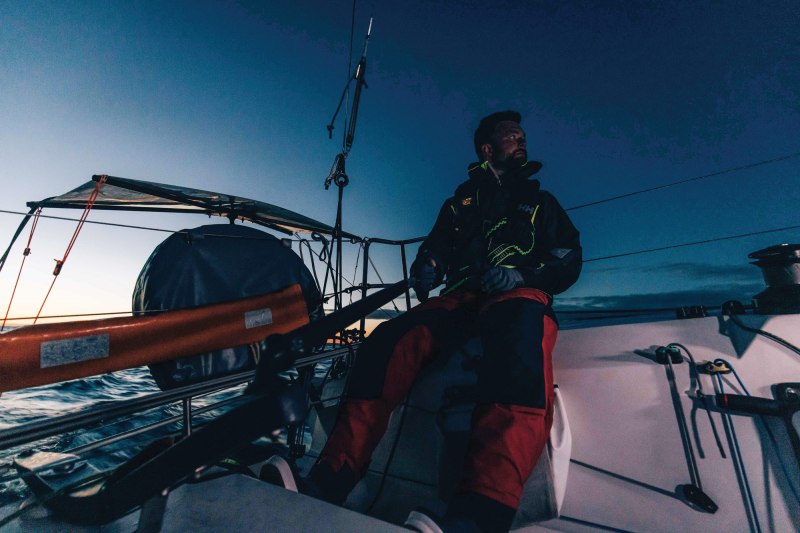 Chasing the horizon aboard the Mini 6.50 Odigo, Debois maintained a stubborn restraint that saw him obliterate the previous record by nearly six days.
Jean-Baptiste D’Enquin/Courtesy Quentin Debois
Chasing the horizon aboard the Mini 6.50 Odigo, Debois maintained a stubborn restraint that saw him obliterate the previous record by nearly six days.
Jean-Baptiste D’Enquin/Courtesy Quentin Debois
The island administrator on San Salvador looked at the gaunt Belgian standing on her dock and asked the only question that mattered. Not about the record. Not about the boat.
“What do you want to eat?”
“A pizza,” said Quentin Debois. Without hesitation.
It had been just over 24 days since the Mini 6.50 Odigo left Cadiz, Spain. Twenty-four days, 19 hours and 31 minutes, to be exact, all of which Debois had spent alone in 21 feet of fiberglass, crossing 4,466 nautical miles of open Atlantic with the B&G autopilot humming below and a router named Basile Rochut watching weather models from the beach. Debois hadn’t just beaten Aina Bauza’s 2024 record of 30 days and 22 hours. He had obliterated it by nearly six days.
He was eating pizza within 20 minutes of stepping ashore.
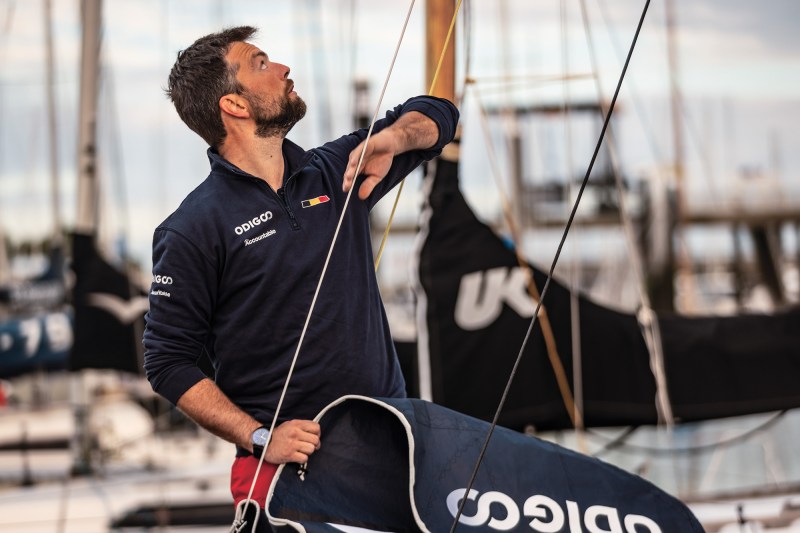 Scrutinizing every shroud, Debois traded reflex for analytical clarity, ensuring Odigo was prepared to solve the Atlantic’s 4,466-mile puzzle.
Jean-Baptiste D’Enquin/Courtesy Quentin Debois
Scrutinizing every shroud, Debois traded reflex for analytical clarity, ensuring Odigo was prepared to solve the Atlantic’s 4,466-mile puzzle.
Jean-Baptiste D’Enquin/Courtesy Quentin Debois
We tend to mythologize the Atlantic—3,000 miles of indifferent blue that demands rugged heroism, bone-deep fatigue and a willingness to “send it” until something breaks. Debois doesn’t see it that way. A few days after his arrival, his voice was clear and unhurried, especially for a man who had just spent a month in a continuous state of motion. I got the sense that for him, the ocean is less a gauntlet than a complex logistical puzzle. One that rewards precision, patience and an almost stubborn restraint.
“I start to feel a little bit rested,” he told me. A humble admission for a man who had just rewritten his country’s maritime history.
Debois is, by any reckoning, an unlikely record holder. He stepped aboard a sailboat for the first time at 31 years old. For those of us who grew up in Optis and 420s, that’s like starting a marathon at mile 20. But his late entry into the sport may have given him something more valuable than ingrained reflex: analytical clarity. He hadn’t spent decades accumulating habits, good or bad. He arrived with a desire to find the most efficient way to move a small boat across a large ocean. He trained in Brittany, France, cut his teeth on the Mini Transat, and eventually gathered a small team around a simple question: What’s the hardest solo record worth chasing?
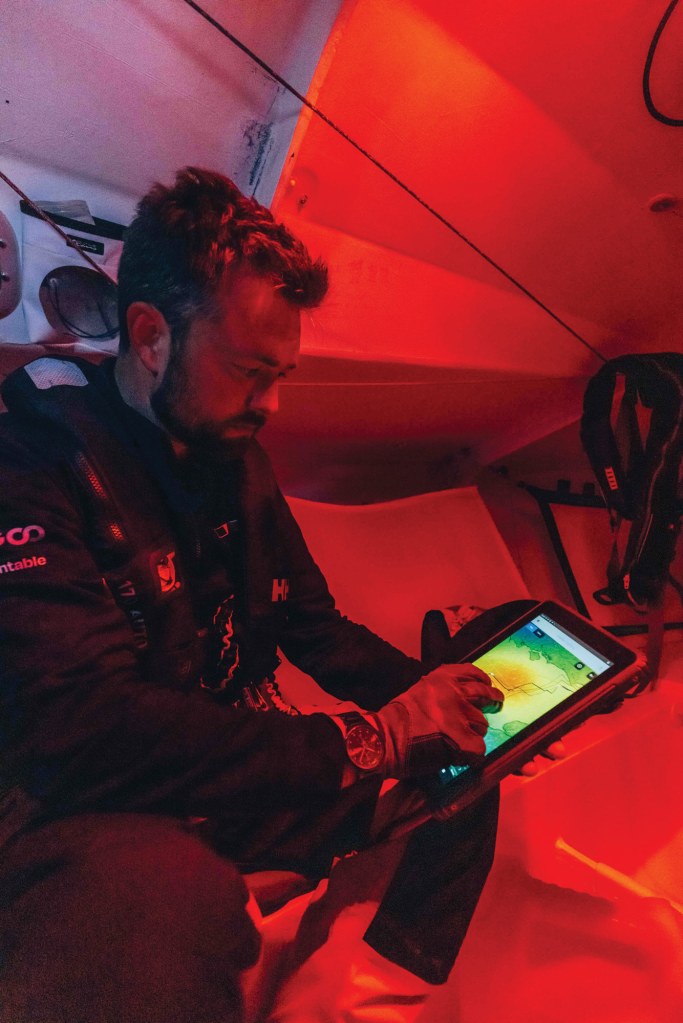 Solo sailing at this level demands a rare brand of disciplined seamanship, where the glow of a tablet is often one’s only companion.
Jean-Baptiste D’Enquin/Courtesy Quentin Debois
Solo sailing at this level demands a rare brand of disciplined seamanship, where the glow of a tablet is often one’s only companion.
Jean-Baptiste D’Enquin/Courtesy Quentin Debois
They chose the Cadiz-to-Bahamas route precisely because it felt off-road. No race committee. No competitors at the start. Just one man, a 21-foot fiberglass bullet and the clock.
When I asked about the physical toll of crossing an ocean inside what amounts to a washing machine for three and a half weeks, Debois pivoted to a term his coach had used: clean sailing.
Pin that to your bulkhead.
“To me, that means good maneuvers, clean maneuvers, good trajectory, getting the boat to a good average speed,” he explained. “Not aiming for peak speed—that’s not the goal—because each time you reach peak speed, you put the boat in a more risky zone.”
Average over peak. Discipline over drama. The next time you’re tempted to keep the big kite flying because the speedo hit double digits for a half second, think about what Debois chose instead: staying inside stable wind systems, and refusing to chase the extreme pressure patterns that might buy a burst of boatspeed at the cost of a blown sail or a compromised spar.
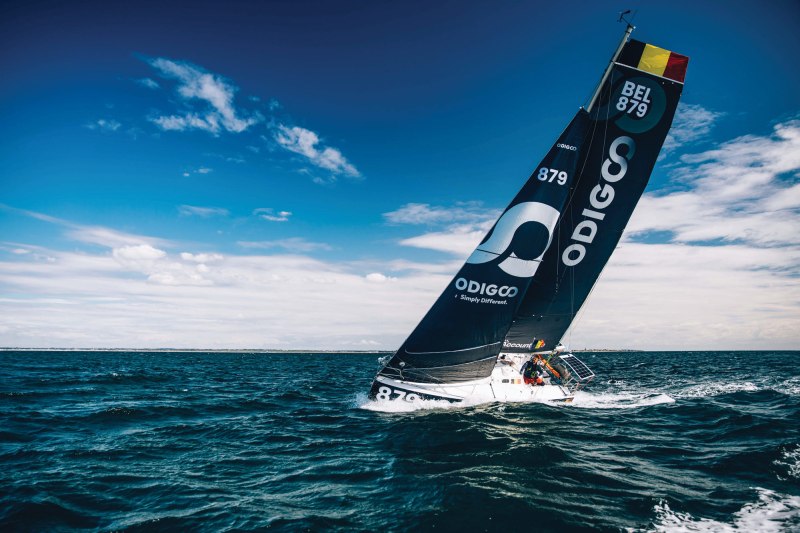 In June, Debois will attempt the solo west-to-east North Atlantic record from New York to Lizard Point, England.
Jean-Baptiste D’Enquin/Courtesy Quentin Debois
In June, Debois will attempt the solo west-to-east North Atlantic record from New York to Lizard Point, England.
Jean-Baptiste D’Enquin/Courtesy Quentin Debois
The man running the big picture was Rochut, operating as what Debois called “my co-pilot from ashore.” In a record attempt of this kind, routing is permitted, and Rochut’s weather analysis was so precise that Debois navigated complex ridge transitions without falling below 10 knots for the entire crossing. Debois continuously cross-checked Rochut’s forecasts against his own real-time observations, and the correlation was, by his account, extraordinary. “It would have been completely impossible without them,” he said, and he meant it.
Then there was the autopilot—what Debois called, with genuine feeling, his “only teammate on the boat.” He had swapped in a B&G system just a month before departure, a decision that likely saved the record. In solo offshore sailing, you already know what that machine means: It’s the reason you can eat, navigate or close your eyes without the boat rounding up. Debois structured his entire existence around 40-minute sleep cycles: nap, wake, scan the horizon and AIS, check the forecast, go back down. “I tried to sleep a total of six, six and a half hours per 24 hours, by accumulating naps,” he said. The first two days are always brutal as the body resists. By day three, his internal clock had recalibrated so thoroughly that he was waking up just before the alarm.
Until he didn’t.
During one extended gusty stretch, he pushed 24 hours without sleep, a decision he made in the moment and regrets entirely. Then he slept through his alarm, which runs at close to 100 decibels, roughly the volume of a jackhammer. He didn’t hear it for a full hour.
“I woke up, wondering what happened,” he said. “I realized I had crashed.”
Nothing was in his path. The boat had held course. But the lesson landed hard: At sea, cognitive discipline is sail trim. You neglect it at the same peril.
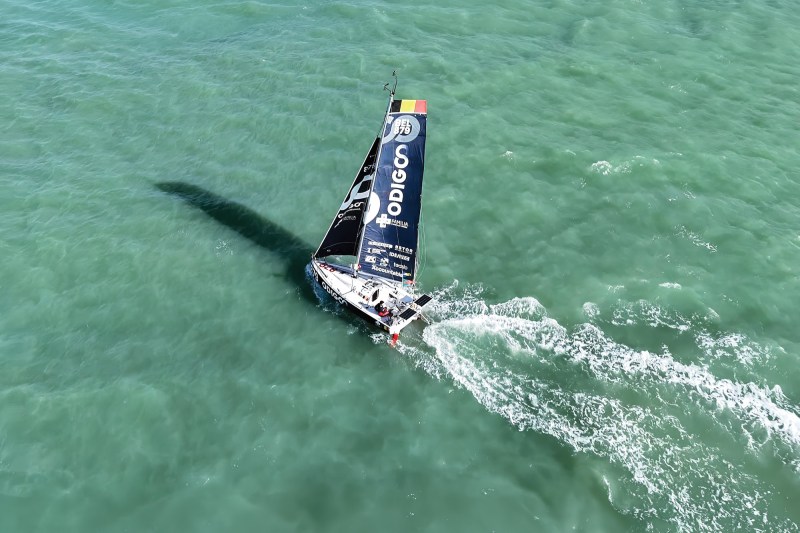 Twenty-four days, 19 hours and a record demolished.
Courtesy Quentin Debois
Twenty-four days, 19 hours and a record demolished.
Courtesy Quentin Debois
On the hardware side, Debois was essentially a full-time carpenter who happened to be racing. He spent an hour to an hour and a half every day on repairs, managing what he called “material fatigue” as a continuous process rather than waiting for failure. “You don’t stop to be a racer to become a carpenter,” he said. “I think you must be both at the same time, all the way.”
Mid-crossing, his bowsprit suffered stress damage. He had a spare, but he also knew the arithmetic: If he broke the second one, the spinnakers were done, and without spinnakers, the record was gone. So he slowed down. For two full days, he used sails that were too small for the conditions, deliberately sacrificing boatspeed to protect the only component he could not afford to lose. “I knew I could push the boat faster for these two days,” he said. “But I decided to slow it down a little bit.”
He lost a spinnaker and a code five when the wind lurched from 15 to 33 knots too fast for him to douse them. He watched the spinnaker shred and made his peace with it. The four sails from UK Sailmakers that survived ultimately arrived in San Salvador in perfect condition—a detail he mentioned alongside the autopilot as perhaps the most critical hardware of the voyage.
There was one more weight Debois carried across the Atlantic, one that no sail plan accounts for: the weight of national pride. As the first Belgian to hold a transatlantic solo record, the pressure before the start was, he admitted, immense. He worked with mental coach Victor Dehaze to find a way to box it out once the dock lines were cast off. “Anything can happen. I can dismast, I can have a rudder issue. I was OK with that,” he says. The acceptance of what you cannot control, applied cleanly and early, kept his morale “excellent” from Cadiz to San Salvador.
The final act of the crossing came five days out from the Bahamas, when the numbers quietly shifted. For the first three weeks, the goal had been simple: arrive in under 30 days. But the data now suggested that sub-25 was possible. Debois called Dehaze. They talked for 45 minutes. Then, in his words, “A new race started for me.” He accelerated, balanced the rising risk against the potential for something truly historic, and arrived with five hours to spare inside the 25-day mark.
Forty people greeted him on the dock. He ate pizza.
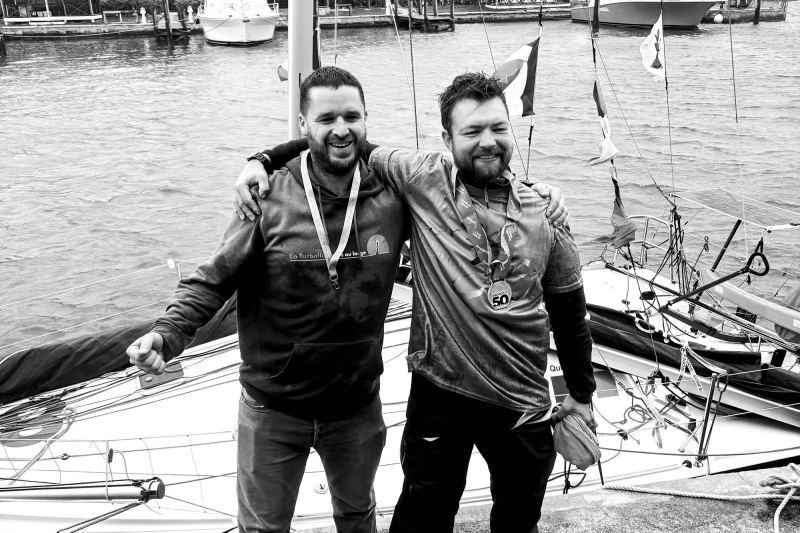 Debois stepped ashore in the Bahamas, trading nearly a month of continuous motion for a well-earned respite.
Jonathan Knowles
Debois stepped ashore in the Bahamas, trading nearly a month of continuous motion for a well-earned respite.
Jonathan Knowles
Now, Debois is looking north and east. In June, he’ll attempt the solo west-to-east North Atlantic record from New York to Lizard Point, England—a harder, faster, more volatile route driven by depressions rather than trade winds. He’s already dissecting his bad habits from this crossing. The biggest one: too much time on social media and communications. For the return leg, he intends to go darker. Fewer dispatches. More boat. In a sport where the margin of victory is measured in hours over nearly a month at sea, the man who shaved six days off a world record by sailing less aggressively is now trying to shave more time by communicating less.
For Quentin Debois, the record wasn’t a destination. It was a data point. The masterclass is still in session.
Lessons for the Long-Range CruiserDebois sailed a 21-foot fiberglass shell. You sail something saner. The principles still hold.
The Power of “Clean” Sailing. Debois prioritized average speed over peak speed, disciplined sail trim over the temptation of a momentary number on the GPS. A steady 7 knots under a conservative plan beats 9 knots followed by four hours of deck repairs, every time.
Your Autopilot Is Your Crew. Debois replaced his autopilot a month before departure and tested it rigorously. In solo offshore sailing, that machine is the reason you can sleep, eat and think. Treat it accordingly. If it’s struggling, you’re struggling. Don’t wait for the mid-Atlantic diagnosis.
The 40-Minute Rule. He slept in 40-minute naps, totaling roughly six hours a day. When he skipped that discipline for 24 hours, he slept through a 100-decibel alarm. Sleep deprivation is the leading cause of poor decision-making at sea. On a shorthanded passage, a rigid sleep schedule matters more than perfect trim.
Route for Stability, Not Just Speed. Shore-based weather router Basile Rochut wasn’t hunting the strongest pressure; he was hunting the most stable wind systems. When the bowsprit was compromised, Debois sailed with too-small sails for two days to protect the rig. Under-canvas early is always the right call when the alternative is a structural failure in the offing.
Repair as a Daily Practice. Sixty to ninety minutes every day on preventative maintenance. He didn’t wait for things to break; he managed fatigue proactively. A daily scan from the bilge to the masthead, even from the deck, catches a chafing sheet or a loose cotter pin before it becomes something else.
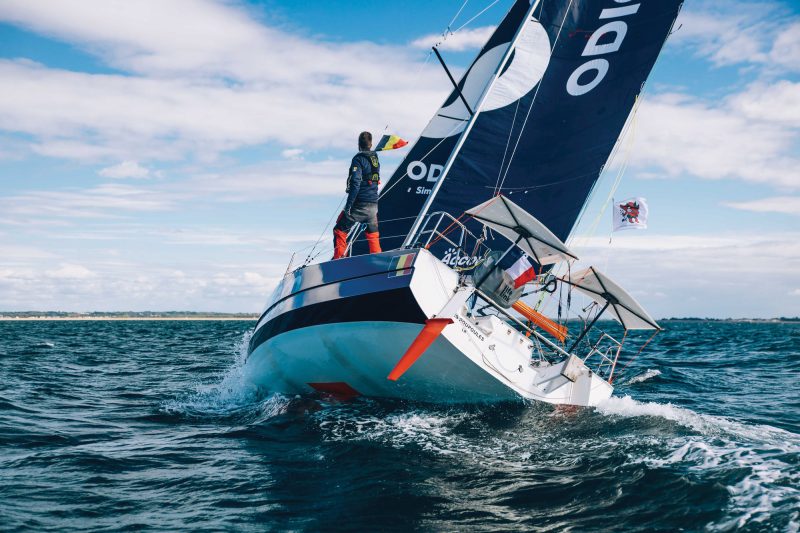 Twenty-four days, 19 hours and 31 minutes, to be exact, all of which Debois had spent alone in 21 feet of fiberglass.
Jean-Baptiste D’Enquin/Courtesy Quentin Debois
Solo, Not Alone
Twenty-four days, 19 hours and 31 minutes, to be exact, all of which Debois had spent alone in 21 feet of fiberglass.
Jean-Baptiste D’Enquin/Courtesy Quentin Debois
Solo, Not Alone
Solitude is the price of admission for a solo transatlantic record. For Debois, the cabin was never truly empty.
His B&G autopilot, replaced and rigorously tested a month before departure, served as his primary tactical partner on board. By trusting it to hold course through his 40-minute sleep cycles, he preserved his own mental bandwidth for the decisions no machine can make: when to ease off, when to push and when to slow down to save the rig.
From shore, weather router Basile Rochut operated as what Debois called his “co-pilot from land,” guiding the boat through complex ridge transitions with forecasts so precise that Debois never fell below 10 knots for the entire crossing. Technical coach Quentin Droneau’s preparation work ensured that material failures like the damaged bowsprit stayed manageable rather than becoming terminal. Mental coach Victor Dehaze was the voice on the satellite phone five days out, when the numbers shifted and a new race needed to start. Michel Lefebvre of UK Sailmakers provided a refined plan specifically tailored to the Mini 6.50’s high-speed reaching angles. Four of those six sails arrived at San Salvador in perfect condition.
Debois offloaded the strategic heavy lifting to his router and the steering to his autopilot, reserving his own cognitive resources for the one function a machine cannot replicate: high-level risk management in real time. For the long-range cruiser, the lesson is clear. Safety and speed are not the products of individual heroics. They are the products of seamless integration, a well-prepared team—onshore or off—and the reliable technology that lets a skipper sleep.
The Return: New York to Lizard PointIn June 2026, Debois will attempt the solo west-to-east North Atlantic record. The Atlantic is a two-way street, and the harder direction runs north.
The trade-wind corridor from Cadiz, Spain, to the Bahamas is more consistent and relatively predictable. The west-to-east North Atlantic is neither. Driven by depressions rather than trades, it is faster in theory and volatile in practice, with cold, heavy air and complex pressure systems from the outset.
“This second crossing won’t be easy,” Debois says. He’s already listing technical improvements: strengthening the deck, further optimizing the autopilot, reducing the communications load that he now sees as a distraction from pure boatspeed. For this leg, he intends to go darker. Fewer updates, more focus, no concessions to the feed.
If he pulls it off, Debois will hold both Atlantic solo records in a single season. Follow the attempt at the World Sailing Speed Record Council tracker.
The post How a Solo Belgian Sailor Crossed the Atlantic 21 Feet appeared first on Cruising World.