Night Vision Without the Thermal Price Tag
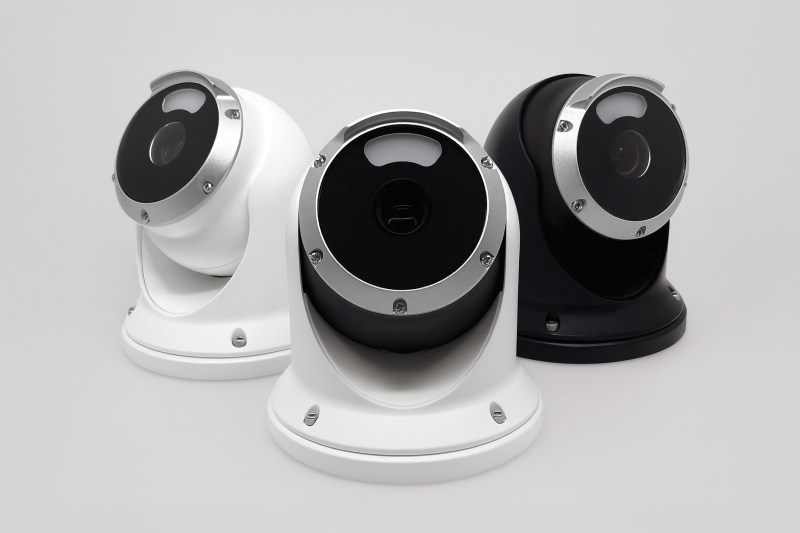 Iris Innovations’ Photon is a high-resolution, low-light camera for use on small or large boats.
Courtesy Iris Innovations Limited
Iris Innovations’ Photon is a high-resolution, low-light camera for use on small or large boats.
Courtesy Iris Innovations Limited
I knew the mooring ball was there, but I couldn’t find it amid myriad others in the darkness. My parents and I were cruising aboard their J/44. We’d spent too much time enjoying a late-afternoon sail on Long Island Sound and not enough time making headway toward Oyster Bay, New York, where we had mooring reservations. The yacht club’s launch driver provided directions over the VHF radio toward the correct quadrant of the mooring field. While conditions were calm, extra visibility would have been helpful.
Thermal-imaging cameras existed, of course, but would have been overkill on that sailboat. Instead, my only option was to bore through the darkness with my flashlight.
When it comes to nighttime navigation, mariners have two optical-based options: thermal-imaging cameras or low-light cameras. Thermal-imaging cameras work by detecting minute temperature differences between objects and their surroundings, whereas low-light cameras work by maximizing available light. Iris Innovations’ Photon low-light camera ($1,250) requires some light to operate, but it leverages onboard AI analytics, LEDs, a processor, a wide-aperture lens and a light-sensitive sensor to generate imagery in near-dark conditions.
Hardware-wise, Photon has a single-payload, radome-enclosed camera that provides ultra-high-definition (4K) onscreen color imagery to a compatible multifunction display or TV screen. The camera measures 5.47 inches (horizontal) by 5.35 inches (vertical), weighs 2.65 pounds, and has an IP67 weatherproof rating. Photon is fixed-mount and doesn’t pan, tilt or offer image stabilization, but it can be zoomed digitally using an optional Iris Innovations CMAC system. Photon cameras have 1/1.2-inch CMOS sensors that deliver up to 8-megapixel image resolution.
Owners can spec a Photon system with a 2.8-millimeter wide-angle lens that yields a 105-degree (horizontal) by 56.1-degree (vertical) field of view, or a 12-mm long-range lens for a field of view that’s 54 degrees by 30.7 degrees. Photon radomes are factory-sealed, so the lenses are not interchangeable. Each lens has an f/1.0 aperture for capturing low-light imagery, but the 12-mm lens allows greater depth of field than the 2.8-mm lens.
Carl Hitchcock, Iris Innovations’ director, says Photon cameras are focused to infinity. This means an object that’s viewed with the 12-mm lens will be displayed onscreen using considerably more pixels than if it was seen through the 2.8-mm lens. Hitchcock says that either Photon configuration can see a 40-foot boat at 1,640 feet, but “with the 12-mm lens, that [boat] is going to appear much larger.”
Additionally, Photon cameras have soft-white LED illuminators that enhance the cameras’ ability to render onscreen imagery at short ranges. Onboard processors apply AI analytics to each of the cameras’ 8.3 million pixels to detect shapes and edges.
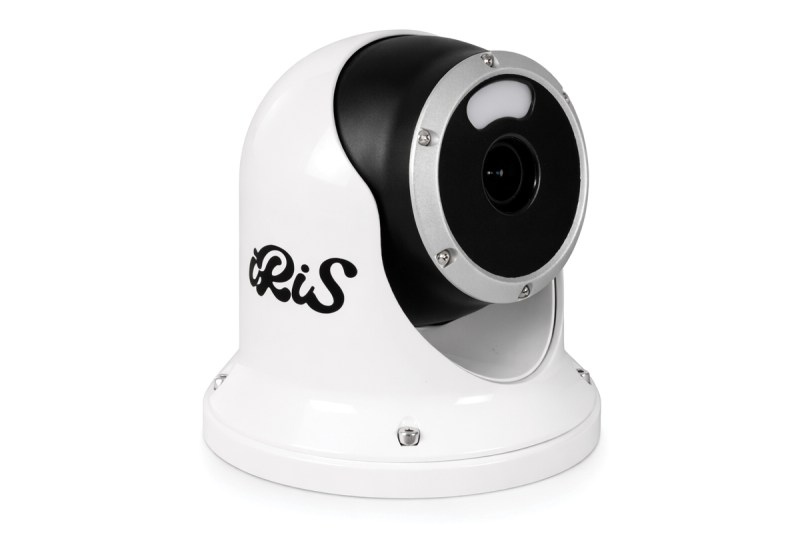 Iris Innovations’ Photon cameras deliver 4K onscreen color imagery to compatible screens.
Courtesy Iris Innovations Limited
Iris Innovations’ Photon cameras deliver 4K onscreen color imagery to compatible screens.
Courtesy Iris Innovations Limited
“Photon gives boat owners reassurance that if they do end up staying out in the water for too long, they’re having too much of a good time and the sun goes down, they can rely on this camera to get them home safely to harbor,” Hitchcock says. “The only limitations are the level of light.”
According to its specs, Photon needs 0.0003 lux to generate imagery. While Hitchcock notes that it’s hard to describe what 0.0003 lux looks like, he says that Photon can deliver full-color, high-definition video in conditions when human eyes can’t discern a newspaper headline from 3 feet. “A moderately starry night is good enough,” he says, noting that moonlight and onshore lights can also work.
While pitch-black conditions are problematic, Hitchcock says, Photon’s LED illuminator (read: not a spotlight) provides enough localized light to allow the camera to depict a small vessel from 400 to 500 feet. While this isn’t enough range to facilitate running safely at 35 knots in the dark, Hitchcock and Gary O’Brien, Iris Innovations’ technical director, say that Photon can enable safe navigation so long as owners exercise throttle discretion.
Photon’s AI analytics further enhance the camera’s ability to render full-color, HD imagery in low-light scenarios, and to combat glare and reflections in broad daylight. “The analytics are looking for shapes, edges and whatever color information it can discern,” Hitchcock says.
However, unlike optical-based collision-avoidance systems, O’Brien says, Photon’s AI analytics doesn’t classify objects in its video stream or offer any navigational alerts. “So, we could say, ‘this is a shape here, this is a shape here,’ not to identify individual vessels,” O’Brien says.
Fog and rain can dog all cameras, and Photon is no exception. “If you can’t see through it with your eyes, you’re not going to see through it with Photon,” Hitchcock says.
As mentioned, networking a Photon with a rack-mounted CMAC ($350 to $1,865) adds capabilities, including digital-zoom controls and the ability to view real-time video feeds from up to 32 cameras on a single display or TV screen. Iris Innovations plans to release a second-generation mini CMAC later this year for around $200. It’s expected to be small enough to fit behind a multifunction display.
As of this writing, Photon integrates directly with Furuno, Simrad and Raymarine multifunction displays, but a CMAC is required to display Photon’s video stream aboard Garmin multifunction displays and most third-party TV screens.
Given Photon’s featherweight pricing and tidy size, it could be a good primary camera aboard center consoles and tenders. But, given that it doesn’t pan, tilt or optically zoom, it could also be well-suited as a secondary camera aboard large sport-fishing rigs and superyachts, especially with the addition of a CMAC, which gives users the ability to digitally zoom and display feeds from multiple cameras on a single screen.
So, if you’re seeking an optical-based solution for occasionally (or unexpectedly) plying the dark—or for seeing through sun glare and reflections—Photon could be worth exploring. As for finding a mooring ball at night, as I did some years ago, there’s little question that a Photon would be a game changer.
Combo CameraIf you’re interested in a low-light camera but want one with higher-level specs, stand by, as Iris Innovations plans to release a multipayload low-light and thermal-imaging camera later this year. The camera is expected to pan, tilt and digitally zoom, with active image stabilization and AI-based features.
New and Notable Marine ElectronicsThe post Night Vision Without the Thermal Price Tag appeared first on Yachting.