Garmin’s GPSMap 1543xsv
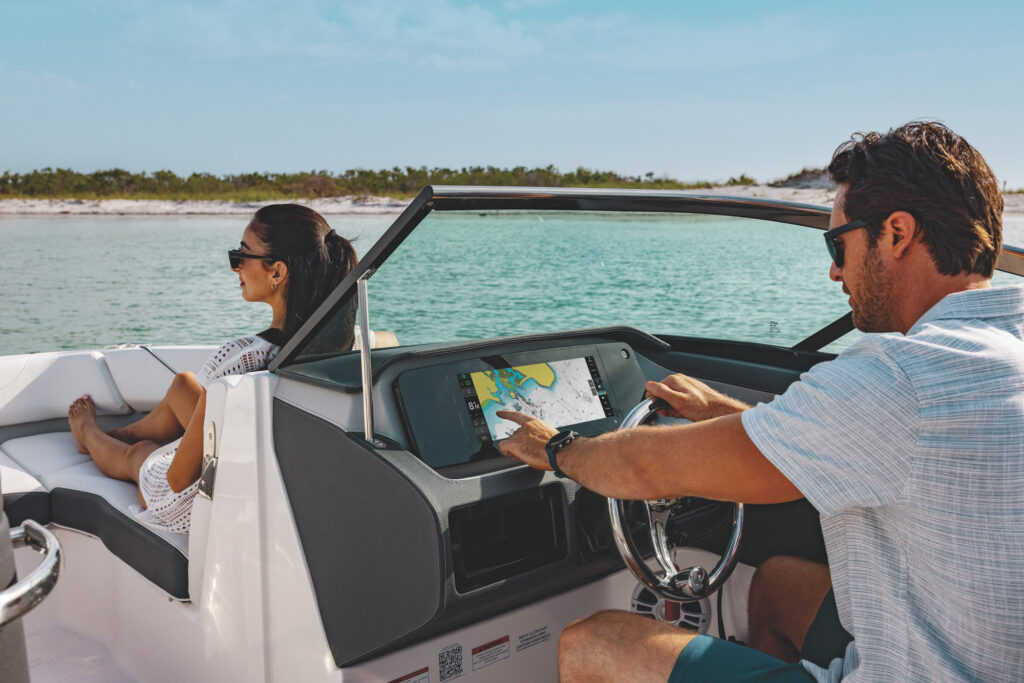 Garmin’s 15-inch ultrawide display has the same amount of glass as two standard 9-inch displays.
Courtesy Garmin
Garmin’s 15-inch ultrawide display has the same amount of glass as two standard 9-inch displays.
Courtesy Garmin
Sometimes a product’s design brief doesn’t align with its adopted uses. Such was the case with the AeroPress, a coffee maker that arrived on my desk about 20 years ago. The marketing material described it as perfect for cruising, camping and travel. While true, the AeroPress delivered world-class cups of joe, and it wasn’t long before coffee addicts (myself included) used it as a daily caffeine-delivery system. Today, there are deep online forums dedicated to perfecting its use.
Garmin’s ultrawide GPSMap 1543xsv is similarly enjoying a reception that’s wider than expected. Garmin originally envisioned this product being an auxiliary screen aboard yachts, but vessels both mighty and modest are embracing the ultrawide format and features.
The GPSMap 1543xsv is a sleek, 15-inch multifunction display that supports a variety of split-screen presentations and fits in locations that other Garmin glass can’t accommodate. The touchscreen display ($4,500) has NMEA 0183 and NMEA 2000 connectivity; built-in GPS, GLONASS and Galileo receivers; two Garmin Marine Network ports; numerous sonars; an IPX7 environmental rating; and in-plane switching that facilitates readability in direct sunlight, even when the user is wearing polarized sunglasses. Each GPSMap 1543xsv also comes pre-loaded with Navionics+ coastal and inland cartography, and can support Garmin’s premium-level Navionics Vision+ cartography.
Each GPSMap 1543xsv measures 15.3 inches wide by 7.02 inches high by 3.3 inches deep. This translates to the same amount of glass as two of Garmin’s 9-inch displays.
“You get the luxury of two 9-inch displays viewed together,” says Dave Dunn, Garmin’s senior director of marine and RV sales. “You don’t have the borders at all, so you get a much cleaner surface area.”
Users can decide how to allocate this screen real estate, with single, double, triple or quadruple views. “You can split the screen any way you want to,” Dunn says, adding that this functionality rivals Garmin’s higher-priced, flagship MFDs. “The screen views interact independently so you don’t have to flip back and forth between, say, sonar and chart.”
This versatility will be familiar to Garmin users, but while other Garmin MFDs place toolbars on the bottom of the screens, the GPSMap 1543xsv’s toolbar is oriented vertically.
“It takes a second to adjust to the toolbar being on the side,” says Dunn, noting that users can place toolbars on either side of the display. “We did that because it gives you more display. It takes up less of the room.”
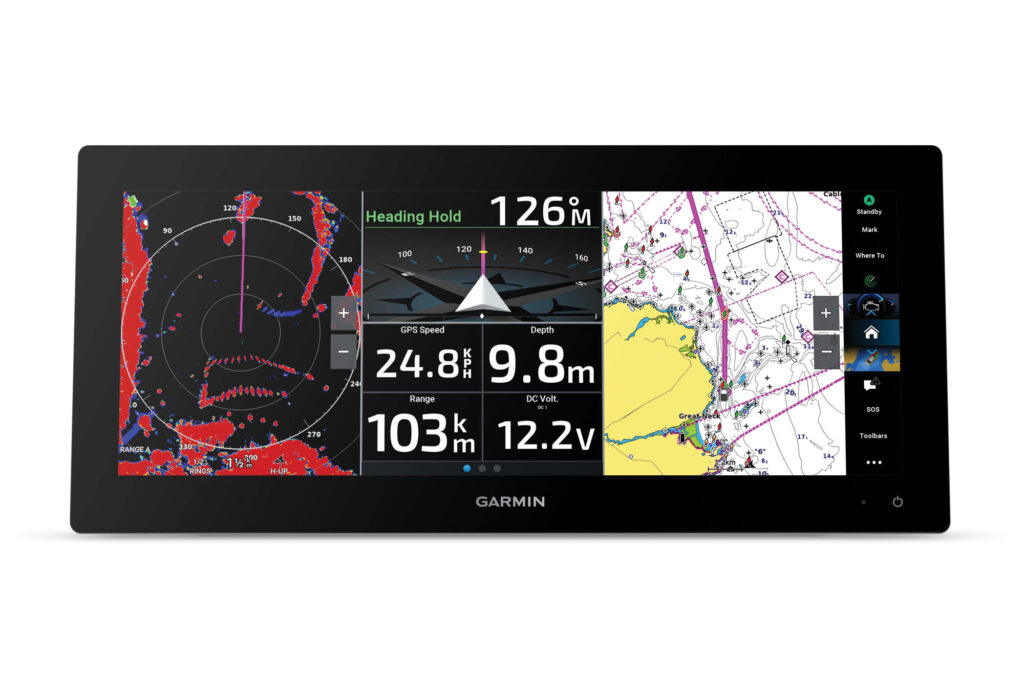 Garmin’s GPSMap 1543xsv can serve as a primary navigation system or as an auxiliary display.
Courtesy Garmin
Garmin’s GPSMap 1543xsv can serve as a primary navigation system or as an auxiliary display.
Courtesy Garmin
The result is more pixels devoted to displaying, say, sonar returns. To this end, each GPSMap 1543xsv has a 1 kilowatt Chirp sonar, as well as embedded SideVü and ClearVü sonars for side- and down-scanning views. The GPSMap 1543xsv can also be networked with downstream Garmin sonar products such as LiveScope, Panoptix and various black-box sonar modules for even more under-keel awareness.
“It doesn’t come with any transducers, and that’s just because there are so many to choose from, and every use case could be different,” Dunn says. “It’s compatible with our full suite of Garmin transducers and Airmar transducers.”
In addition to sonar compatibility, the GPSMap 1543xsv can control and display third-party daylight and thermal-imaging cameras. It can also be networked with other Garmin MFDs or with compatible Mercury or Yamaha engines. Also, NMEA 2000 data such as depth, speed and water temperature can be shared wirelessly with connected Garmin quatix nautical smartwatches. Users can also use the quatix to adjust the yacht’s autopilot.
One reason Garmin originally envisioned the GPSMap 1543xsv as an auxiliary display for yachts is that it can serve as a user interface for Garmin or third-party digital-switching systems. Other Garmin MFDs can also fill this niche, but the GPSMap 1543xsv’s physical shape is important. “It fits in places that the traditional screens can’t go,” says Dunn, describing helm spots too small for a 12-, 15- or 27-inch screen.
It’s also possible to run a GPSMap 9000 series display at the helm and a GPSMap 1543xsv on the flybridge. “Some of the older sportfish or cabin cruisers don’t have a ton of room on top,” Dunn says, adding that boaters using it as a secondary screen has been a pleasant development. “We made it capable of doing that. We just didn’t think a lot of people would gravitate to it and, to our surprise, they have been.”
This same surprise extends to the GPSMap 1543xsv’s adoption rates aboard smaller vessels. “We’ve seen them on kayaks. We’ve seen them on bass boats as well as center consoles,” Dunn says.
The GPSMap 1543xsv does lack Garmin’s 1 Gbps BlueNet ports, however, this can be overcome by adding a Garmin BlueNet 30 Gateway ($350). Also, the GPSMap 1543xsv’s screen shape could make it a touch less effective for route planning than a standard-format display.
That said, the deep-water column of features looks promising. For anyone who is running a digital-switching system, the GPSMap 1543xsv is far more cost-effective than some of Garmin’s bigger glass.
If you cast or cruise with Garmin gear, the GPSMap 1543xsv is worth a look. Personally, I suggest doing this research at home with a cup of AeroPress coffee, as one product that assumed its own life could be good inspiration for another.
The post Garmin’s GPSMap 1543xsv appeared first on Yachting.