What to Look for in a Water-Purification System
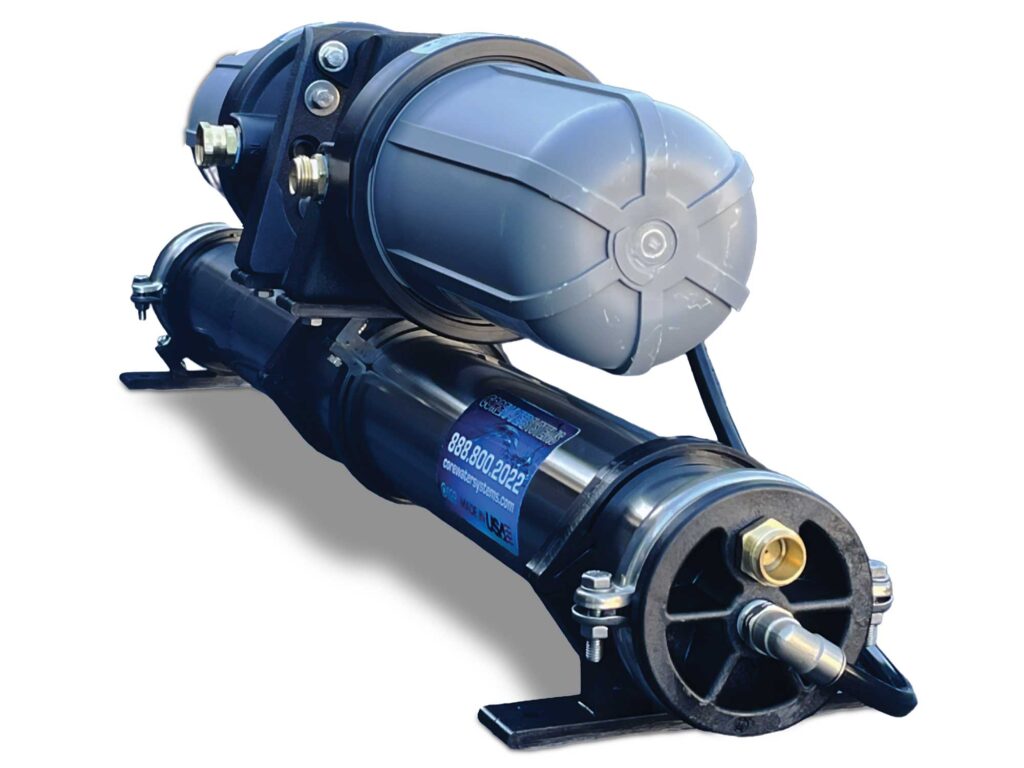 The hand-carry single-membrane three-stage reverse-osmosis water-purification system from Deckhand Supply retails for $1,861.64.
Courtesy Deckhand Supply
The hand-carry single-membrane three-stage reverse-osmosis water-purification system from Deckhand Supply retails for $1,861.64.
Courtesy Deckhand Supply
Using a water-purification system to wash and rinse your boat once it’s back at the dock or on a trailer can save you time and help keep finishes spot-free and gleaming. These systems are especially helpful if the water supply contains an abundance of dissolved solids that can leave ugly-looking hard-water deposits on gelcoat and metal surfaces, particularly if not promptly wiped dry with a chamois or microfiber towel. To learn more, we talked with Eric Johnson from Deckhand Supply (deckhandsuppy.com) in Huntington Beach, California, who offers these tips to boaters thinking about a water-purification system.
RO vs. DIThere are two basic technologies for water purification—reverse osmosis (RO) and deionization (DI). The purchase price of a RO system is far greater than a comparable DI system (purchase prices outlined below), but replacement filters and membrane elements needed to service a RO system cost substantially less than the replacement resin needed for a comparable DI system, according to Johnson.
On one of Deckhand Supply’s least expensive RO systems, it costs about $80 to replace the sediment filter and carbon filter, both of which last on average 2 to 6 months. The RO membrane costs $480 to replace, but it lasts 3 to 5 years.
With a comparable DI system, it costs about $230 for replacement resin that will last 1 to 3 months. “While factors can vary, a typical recreational boater will get approximately one season of use before replacing elements with either RO or DI,” Johnson says.
At its peak, a RO system can reduce total dissolved solids (TDS) to about 7 to 10 parts per million (ppm), Johnson says. A DI system, on the other hand, can beat that with as few 0 ppm or 1 to 5 ppm at the most. However, there is a danger with DI—when flowing, the presence of dissolved oxygen in DI water has a propensity to corrode unprotected aluminum, especially in hot climates. Other metals such as stainless steel are not affected.
Read Next: How to Clean Your Boat Without Dirtying the Environment
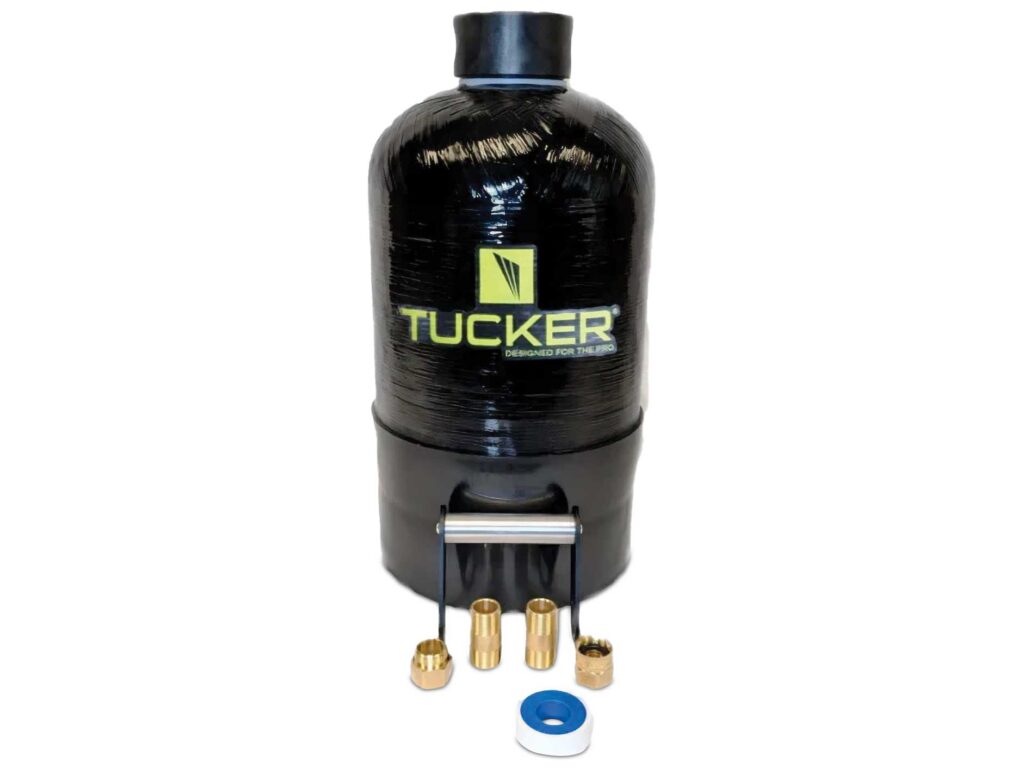 The HandyPure Tank deionization system from Tucker USA is light enough to hand carry and retails for $471.45.
Courtesy Tucker USA
BUY NOW
Permanent vs. Portable
The HandyPure Tank deionization system from Tucker USA is light enough to hand carry and retails for $471.45.
Courtesy Tucker USA
BUY NOW
Permanent vs. Portable
Permanent systems are generally reserved for boats kept in marina slips or residential docks. These systems are often fabricated for a neat installation within the protection of a dock box and plumbed with a water supply and wired for AC power, Johnson says. Given the custom nature and installation costs, permanent systems range higher in price than portable systems. For example, Deckhand Supply’s Reverse Osmosis (RO) Dock Box System with dual-membrane three-stage filtration and a booster pump starts at $6,895, excluding installation.
Portable systems are often light enough to be hand-carried or mounted on a rolling hand-cart, providing convenience for trailer boaters, as well as boats kept in the water. They are less pricey than permanent systems, Johnson points out. Deckhand Supply offers a hand-carry RO purification system for as little as $1,861.54. Portable deionization (DI) systems are available for as little as $471.45 from tuckerusa.com.
Pressure WasherJohnson recommends against using a pressure washer with RO because the filtration system might not provide sufficient flow to feed the pressure washer. Also, when throttled down, the washer can create back-pressure that might damage the RO membrane. If you want to use a pressure washer, you will need to add a buffer tank that isolates the RO system and provides sufficient water to the pressure washer. On the other hand, you can safely use a pressure washer with most DI systems.
TDS TesterJohnson recommends buying a TDS tester ($9.99; amazon.com) to accurately determine the total dissolved solids in the water supply. More importantly, by testing the water produced by the system, it will help you decide when the purification elements are no longer working effectively and need to be replaced.
The post What to Look for in a Water-Purification System appeared first on Boating Mag.